
But when planning a badminton court, getting the badminton court dimension correct is one of the most crucial steps. When a court is built for a sports academy, school, your own club, commercial facility or private property with exact measures you are able to establish the safest and professional playing environment.
At first glance, a badminton court may seem simple, but the setup calls for numerous specific measurements. You need to consider overall dimensions and width, singles court lines, doubles outer lines / sidelines, service lines [both back & side] sideline clearance net and its position.
The key to avoiding serious errors and getting the finished court to give enough room for moving around but also competitive play is knowing these measurements by heart before you even look at any construction projects.
Standard Badminton Court Dimension
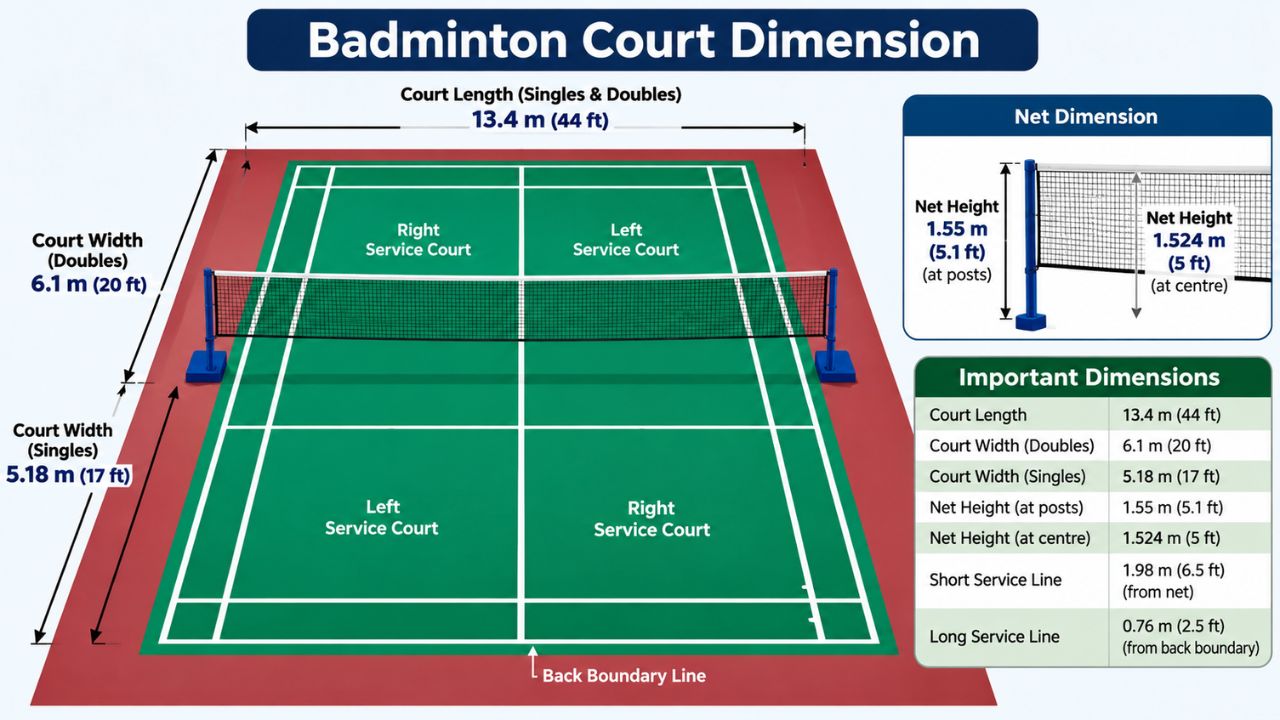
Dimensions of Badminton Court The basic measurement for badminton court is 44 feet long (roughly 13.40 metres). The width will also vary depending on whether the court is for singles or doubles matches.
For doubles matches the full width of the court is 20 ft (≈ 6.10 m). In singles matches, players use the inner sidelines which provides 17 feet (approximately 5.18 m) of playing width.
This is to say that the draw differential by which you see courts of varying widths gets smaller when they’re built accordingly. This means that a standard doubles court is marked in such a way, that it can equally be used for singles.
A full doubles court weighs in around 880 sq ft of playing area compared to the approximate total of 748 sq ft for singles.
The above measurements are the basis of badminton court dimension, but it is not the only data needed when building.
Singles and Doubles Court Measurements
When playing both Singles and Doubles badminton, players play on the same physical court but differ in the boundary lines.
If the doubles match is played, the outer sidelines are in play and the players have a full 20-foot width. For singles, the inner sidelines apply, and it narrows your playing width to 17 feet.
Both formats have a total length of 44 feet.
This distinction matters especially when setting out a newly prepared court. Using the wrong sidelines at any point in play will make the playing area not conform to that particular format.
Having both sets of lines is useful because a single court can serve for singles and doubles games without needing to be altered.
Court Lines and Their Importance
Multiple lines forms the court of badminton which has different purpose such as hitting and serving area.
The outer perimeter corresponds to the global dimensions of the court. This includes the short service lines, centre line, singles sidelines, aThe nd doubles long service line.
Each side has a short service line, set about 6 feet 6 inches (1.98 m) from the net.
The centre line splits each individual service area into a left and right service court. These sections are used by players while serving diagonally to opponents.
The long service line is a distance of about 2 feet 6 inches, or 0.76 metres, inside the rear boundary for doubles. In singles, the back boundary (the one behind the server’s end) is the long service line.
This high precision is necessary since many lines are situated physically close together. Even the tiniest mistake can create havoc for players in terms of a confusing layout of the court.
Badminton Net Height and Position
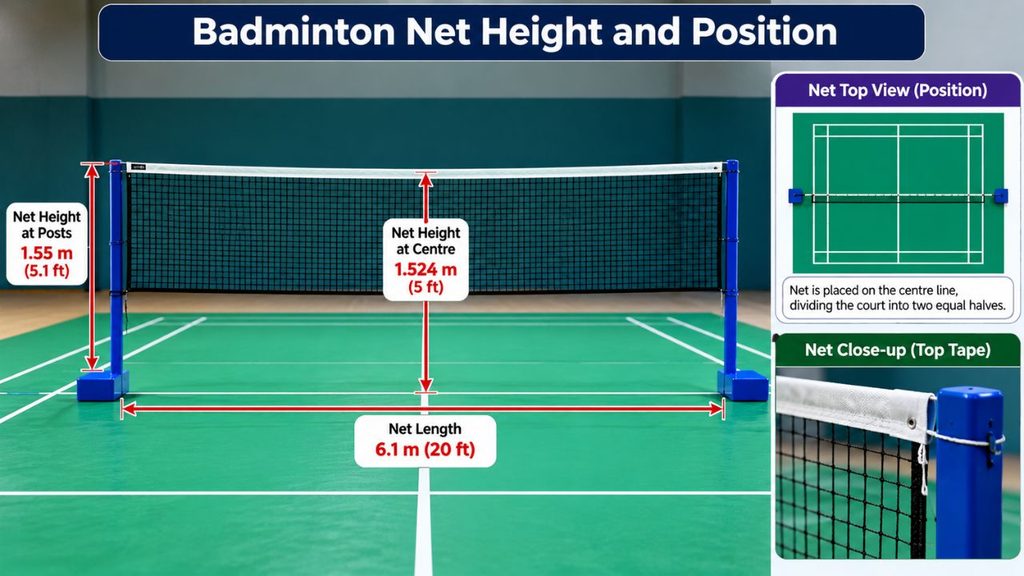
Of a similar nature is net, which is fitted centre court to practice range and split into half for play.
The court is 44 feet long, so the net is placed roughly 22 feet from each end of the court.
At the net, which is about 5′ in height. Height is about 5FT1 at the posts
The slight variance in the centre and post height allows the net to keep its shape when set correctly.
The net posts are placed on the doubles sidelines. It lends itself to both singles and doubles matches.
While verifying the full badminton court dimensions, net height, and position of beam check with line markings on the floor. A floor of correct dimensions but with an incorrectly positioned net can still play havoc with the quality of play.
Space Around the Badminton Court
It does not actually exist in the playing court that makes up a badminton facility.
Players frequently carry over the line when attempting fast or difficult shots. They require sufficient amount of free space behind and beside the court to be able to safely move and slow down without immediately coming up against a wall or other obstacle.
As a practical planning reference, around 6.5 feet of clearance or more all the way around the court could be considered an appropriate baseline. If the property that is available permits, more space is ideal.
A doubles court of 44 feet by 20 feet may have about a footprint requirement of around 60-foot by 34-foot with the addition of necessary movement area.
The overall footprint will vary based specific facility use, safety requirements, seating arrangements, walkways, storage areas and more.
And this is also why builders should never determine the building size needed by only assessing the playing court.
Indoor Court Height Requirements
So badminton, too, is more sensitive to overhead clearance since clears and lifts take the shuttle up into the air.
Low ceiling certainly gets in the way of normal gameplay, and just ends up with players constantly hammering the shuttle into above-head surfaces.
While a planning target for a clear ceiling height in the area of 20 feet is helpful for recreational facilities. More height may work better for facilities that are meant for serious training or competitive play.
Try to leave the area just above the court as free from obstruction as possible. Position structural beams, fans, lighting fixtures, air-conditioning equipment, ducts and other installations with care.
Integrating good vertical clearance is indeed a competent aspect of the badminton centre design.
Badminton Court Dimension for Different Facilities
Based in part on the Court Layout section of Tennis QuickStart, registered facilities should generally follow standard playing dimensions whenever possible, although some variation may be required depending upon the purpose and nature of the facility.
Since badminton players work in a unique environment, standard measurements are required at a professional badminton academy for training and competition.
Standard court dimensions can be useful for schools and community centres as well. Allows students and recreational players to practice with a facility layout that is available in organized badminton.
Often residential courts have more constraints with space. In the event that there is not enough room for a complete doubles court along with sufficient safety clearance, it might be suitable to use an integrated recreational format.
But reducing the area where you play is a different game altogether. It is also important to keep the dimensions of a standard badminton court when building a court specifically for serious training.
You should also think about the area surrounding the new structure. Additional walkways, seating equipment storage, changing areas, and access routes can further add to the overall required space.
Flooring and Court Surface
Accuracy in measurements is just one aspect of a quality badminton court. Player comfort, movement and safety are also greatly impacted by the playing surface.
Base – the base must be level and solid as well graceless for the selected games flooring system. An uneven floor is bad for footwork and leads to different issues in the future with court markings.
Most badminton venues utilize professional sports flooring that is specially engineered to give proper traction and shock absorption.
The surface should be such that it allows court lines to remain evident. The difference between the colour of the floor versus the markings makes it simpler for players to see things like their boundaries and service areas.
All measurements must be double-checked before beginning any permanent line marking work. It is very difficult and often expensive to correct a measurement error after the surface has been painted or installed.
Common Court Measurement Mistakes
The most avoidable issue during badminton court construction is incorrect measurements.
The singles and doubles sidelines are two of the most common areas where people make mistakes when playing tennis. An additional one is, your measure for service lines are from wrong reference point.
Others not checking if the court is square. One of the easiest ways to check its layout is by measuring the diagonals between two opposite corners. Equal diagonals imply the corners are adjusted more precisely.
Or a lack of clearance left around the court can create other issues. For example, a court will have the proper dimensions but not be safe enough to play on if it is located too closely to a wall.
Overhead obstacles are another issue. The playing area should not be interfered by lights, fans, beams and other fixtures.
However, these problems can be avoided by making sure to double-check all measurements before you install.
How to Measure a Badminton Court
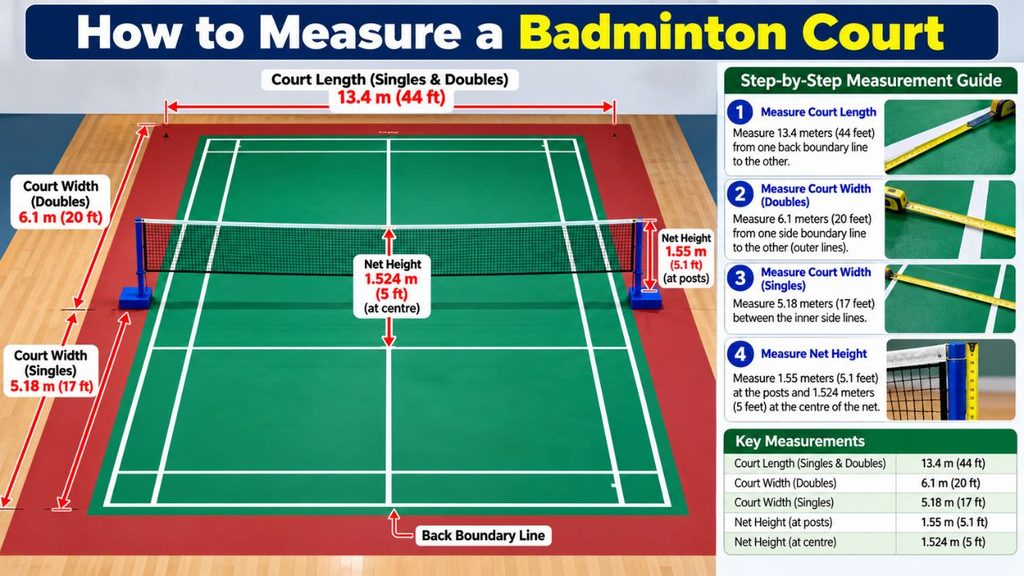
You should first measure the court location and orientation method in your measurement process.
The length of 44 feet at full should be laid out next, then the proper width is established, typically 20 feet for doubles or a 17-foot singles playing width.
After the boundaries have been established, check the corners to ensure that a semi-accurate rectangle is formed by legs of the court.
This can then lead to the net position at the center of the court. Next we can mark the service lines and centre line based on their desired positions.
Invest in a good quality tape measure, or laser measurement which can help with accuracy It is also useful for temporary reference lines before permanent marks are added-a chalk line or string will suffice.
Its best to take more time needed to verify the badminton court measurement before getting the court painted than identified an error once the courts are done.
Quick Reference for Badminton Court Measurements
For easy reference, the standard measurements can be summarized as follows:
| Measurement | Standard Size |
| Court length | 44 feet / 13.40 metres |
| Doubles court width | 20 feet / 6.10 metres |
| Singles court width | 17 feet / 5.18 metres |
| Doubles playing area | Approximately 880 sq. ft. |
| Singles playing area | Approximately 748 sq. ft. |
| Net height at centre | Approximately 5 feet |
| Net height at posts | Approximately 5 feet 1 inch |
| Short service line | Approximately 6 feet 6 inches from net |
| Doubles long service line | Approximately 2 feet 6 inches inside rear boundary |
These figures describe the playing court itself. Additional space should be added around the court for player movement and facility requirements.
FAQ About Badminton Court Dimension
1.What is the standard badminton court dimension?
A standard doubles court is 44 feet long and 20 feet wide, while the singles playing width is 17 feet.
2. Is the length different for singles and doubles?
No. Both singles and doubles use a court length of 44 feet. The main difference is the width used during play.
3. How high should a badminton net be?
The net is approximately 5 feet high at the centre and around 5 feet 1 inch at the posts.
4. How much space should be left around a badminton court?
A clearance of around 6.5 feet or more around the playing boundaries is a practical planning benchmark. Additional space can improve player safety and comfort.
5. Does ceiling height matter for badminton?
Yes. Sufficient overhead clearance is important because the shuttle can travel high above the playing surface. Around 20 feet is a useful planning target for recreational indoor facilities, with greater height preferable for more demanding use.
6. Can the same court be used for singles and doubles?
Yes. A properly marked standard court can accommodate both formats. Singles uses the inner sidelines, while doubles uses the outer sidelines.
Conclusion
An important factor for providing a safe and functional playing environment is getting the badminton court dimension right. A standard court is 44 feet long, and doubles play uses a width of 20 feet while singles play permits a width of only 17 feet.
However, developing a facility for badminton is far beyond simple dimensions. Service lines, height above the net, clearance around the court, ceiling height and other construction facility requirements need to be determined before mega-structures are broken ground.
Whether that court tor is being created for a the residence, college, academy, club or industrial sports activities centre, right planning can make all of the difference. Court supporters play perfectly over casual use and dedicated badminton training with standard measurements and space around & overhead.
Also Read: How Big Is 6 Inches | How Tall Is 17 Inches | How Tall Is 59 Inches
How Long Is 5 Meters | How Tall Is 300 Feet | How Big Is 2 cm