 11
Alcohol bottles come in a variety of sizes, shapes and measurements. Each bottle is designed with the specific needs of the beverage it holds in mind. The bottle size that will best suit your needs depends on the type of alcohol you plan to purchase, the brand of alcohol, and the country where the product is sold. No matter if you are looking at whiskey, vodka, rum, wine, or beer bottles, knowing the bottle size of your preferred drink can help you determine how much alcohol is in each bottle.
Alcohol bottle sizes represent how much liquid is contained within each bottle. Most commonly, alcohol bottles will have their capacity listed in either milliliters (ML), liters (L), or fluid ounces (fl oz).
Alcohol bottle size will vary depending on what the user wants to use it for, the type of drink, and how products are packaged based on the area.
For example, most liquor bottles manufactured in the U.S. generally contain 750 ml of fluid. However, 700 ml bottles are common in many parts of Europe. Most liquor sold in India can be found in 180 ml, 375 ml and 750 ml bottles.
Knowing how to measure the amount of liquid within a container will make it simpler to compare similar items, as well as determine the volume of liquid present in each item.
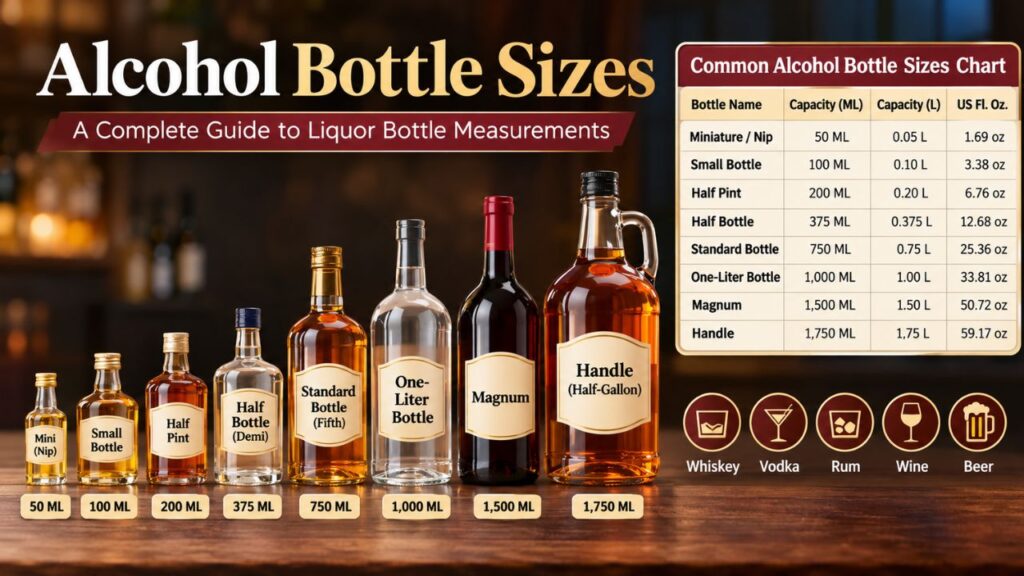
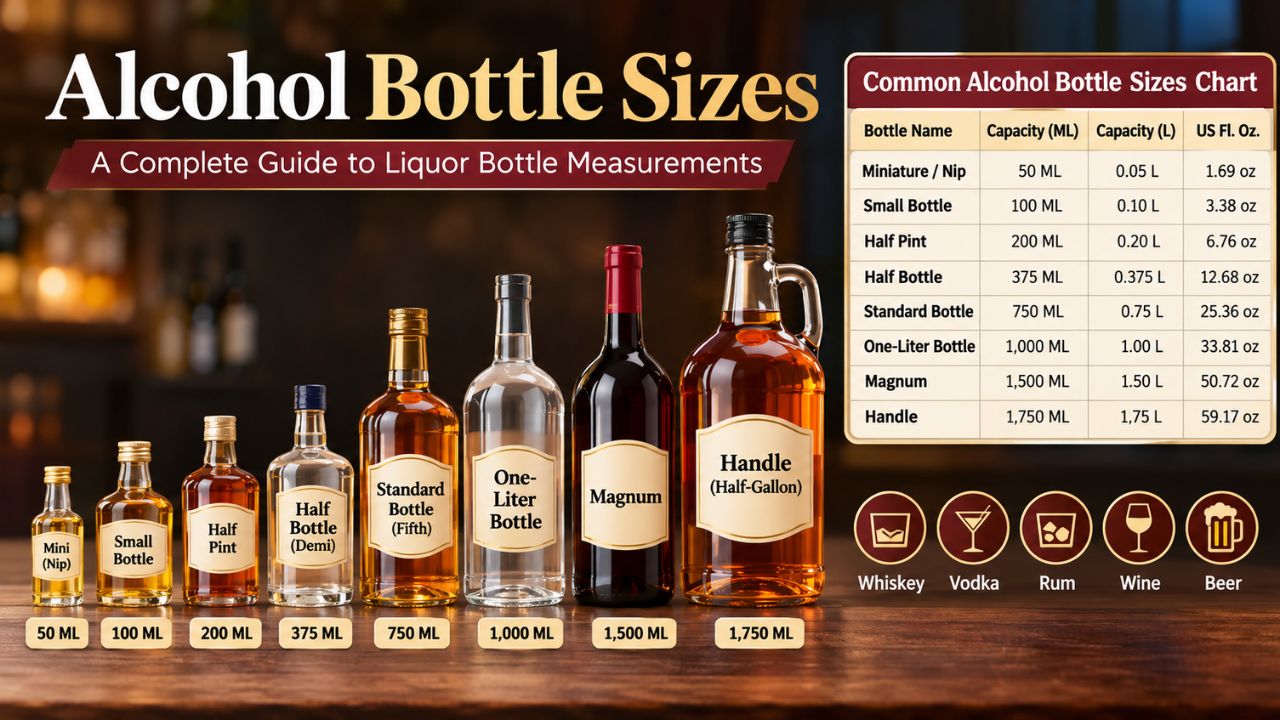
Here is a comparison of commonly recognized alcohol bottle sizes with their approximate measurements.
| Bottle Name | Capacity in ML | Capacity in Liters | US Fluid Ounces |
| Miniature / Nip | 50 ML | 0.05 L | 1.69 oz |
| Small Bottle | 100 ML | 0.10 L | 3.38 oz |
| Half Pint | 200 ML | 0.20 L | 6.76 oz |
| Half Bottle | 375 ML | 0.375 L | 12.68 oz |
| Standard Bottle | 750 ML | 0.75 L | 25.36 oz |
| One-Liter Bottle | 1,000 ML | 1 L | 33.81 oz |
| Magnum | 1,500 ML | 1.5 L | 50.72 oz |
| Handle | 1,750 ML | 1.75 L | 59.17 oz |
| Double Magnum | 3,000 ML | 3 L | 101.44 oz |
| Large Format | 4,500 ML | 4.5 L | 152.16 oz |
| Imperial | 6,000 ML | 6 L | 202.88 oz |
Note: Bottle names and capacities can vary depending on the beverage category and country.
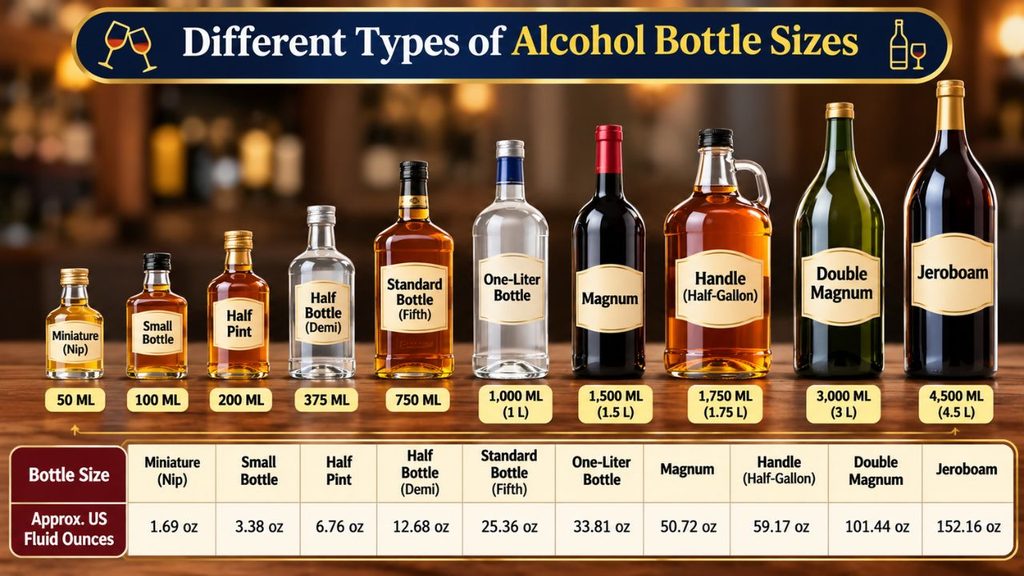
Alcohol bottles are available in several standard capacities. Each size has its own name and packaging purpose.
A 50 mL bottle is referred to as a miniature, mini, or nip. This size bottle is one of the smallest commercial spirit bottles on the market.
These types of bottles can be stored easily because they are small. You will see these types of bottles in some of the most popular brands of whiskey, vodka, rum, and other alcoholic beverages.
A 50 ML bottle holds approximately 1.69 US fluid ounces.
A 100 ml bottle is also a small package option. The 100 ml bottle holds about 3.38 US fluid ounces.
The product size offered within this category of products can be purchased in some types of drinks. This size will also work well with small-scale retail packaging needs.
In the U.S. liquor industry, a 200 ml bottle is often referred to as a “half-pint”.
The bottle has about 6.76 American fluid ounces. It is bigger than most mini-bottles and smaller than standard bottles.
A 375 ML bottle is commonly called a half bottle in wine packaging.
This product is the equivalent of one-half of a standard 750 ML bottle, and has a volume of about 12.68 US fluid ounces.
The availability of this format varies by wine and/or spirit product manufactured.
This is an extremely popular alcohol bottle size across the globe.
In the United States, it is traditionally called “a fifth” as it is roughly equivalent to one-fifth of a U.S. gallon.
The container has about 25.36 United States Fluid Ounces of liquid and is typically used to hold whiskey, vodka, rum, gin, and wine.
A one liter bottle will contain 1,000 ML (Milliliter) of water, which is a bit bigger than the standard 750 ML bottle.
Distilled spirits and many other types of drink are typically sold in this packaging format. This format is well-known internationally as a standard unit of measure in the retail industry.
A Magnum bottle holds 1.5 liters or 1,500 ML of liquid.
The package has the same amount of liquid as two regular 750 milliliter (ml) wine bottles, making it very common for packaging wine.
The use of magnum bottles is common in celebration events, upscale displays, and for service to guests in hospitality environments.
A 1.75-liter bottle is commonly known as a handle in the United States.
This name was derived from the handle found on some bottles of this size, which makes it much simpler to move large amounts of fluid.
The product holds about 59.17 U.S. fluid ounces, and it is usually offered for some of the select distilled spirits.
Large-format bottles have become very popular for use as packaging for both wine and sparkling wine products. These large-format bottles are typically seen as being a more upscale way of presenting products to consumers, as well as a great option when it comes to special events.
| Bottle Name | Capacity | Equivalent 750 ML Bottles |
| Magnum | 1.5 L | 2 |
| Double Magnum | 3 L | 4 |
| Jeroboam (Still Wine) | 4.5 L | 6 |
| Imperial | 6 L | 8 |
| Salmanazar | 9 L | 12 |
| Balthazar | 12 L | 16 |
| Nebuchadnezzar | 15 L | 20 |
The traditional names of large-format bottles can differ between still wine and sparkling wine.
There are multiple ways that whiskey can be purchased. These include smaller (miniature) bottles and larger format containers.
The 750 ML bottle is a standard size that has become popular in the U.S., while 700 ML bottles have gained popularity in many different countries.
| Whiskey Bottle Type | Capacity |
| Miniature | 50 ML |
| Small Bottle | 100 ML |
| Half Pint | 200 ML |
| Half Bottle | 375 ML |
| Standard Bottle | 700–750 ML |
| Large Bottle | 1 Liter |
| Magnum | 1.5 Liter |
| Handle | 1.75 Liter |
The bottle size is unrelated to the quality of the whiskey, how old it is, or its alcohol content. All three of those are different aspects of the whiskey.
Vodka is usually packaged into glass bottles with varying amounts of fluid. Manufacturers, brands, and local markets dictate what size of bottle can be used.
| Vodka Bottle Type | Capacity |
| Miniature | 50 ML |
| Small | 100 ML |
| Medium | 200 ML |
| Half Bottle | 375 ML |
| Standard | 750 ML |
| Liter Bottle | 1,000 ML |
| Magnum | 1,500 ML |
| Handle | 1,750 ML |
The 750 ML and 1-liter formats are familiar packaging options for vodka in many markets.
Rum is available in several bottle capacities, including compact bottles and larger retail formats.
| Rum Bottle Size | Capacity |
| Mini | 50 ML |
| Small | 180–200 ML |
| Medium | 350–375 ML |
| Standard | 700–750 ML |
| Large | 1 Liter |
| Extra Large | 1.5 Liter |
| Handle | 1.75 Liter |
The exact packaging options vary according to the product range and regional availability.
Wine bottles are available in a much larger number of traditional names and sizes than most other types of beverage packaging.
A 750 ML bottle is the most common size, however, wines come in other sizes of smaller and larger bottles.
| Wine Bottle Name | Capacity | Equivalent Standard Bottles |
| Piccolo / Split | 187.5 ML | ¼ |
| Demi / Half | 375 ML | ½ |
| Standard | 750 ML | 1 |
| Magnum | 1.5 L | 2 |
| Double Magnum | 3 L | 4 |
| Jeroboam | 4.5 L | 6 |
| Imperial | 6 L | 8 |
| Salmanazar | 9 L | 12 |
| Balthazar | 12 L | 16 |
| Nebuchadnezzar | 15 L | 20 |
These large bottles are often associated with wine collections, as well as being used for premium packaging, and in hospitality settings such as at celebrations.
Beer is available in glass bottles, aluminum cans, and other packaging formats.
Individual servings of beer are packaged differently than spirits and wine. Individual-serving containers of beer are used more often than those of spirits and wine.
| Beer Packaging Type | Common Capacity |
| Small Bottle | 250 ML |
| Standard Bottle | 330 ML |
| Large Bottle | 500 ML |
| Pint Can | 568 ML |
| Large Can | 650 ML |
| Sharing Bottle | 750 ML |
These are commonly encountered packaging formats, but actual sizes differ across countries and manufacturers.
Alcohol bottles are packaged differently around the world. Each country follows its own packaging regulations and retail customs.
The most common sizes of alcohol packages that are sold in India are 180 ML, 375 ML, and 750 ML. Additionally, there may be some types of alcohols which can be purchased in a one-liter package.
In the U.S., 750 ML is a common standard size of spirit bottles. In the U.K. and many other European countries, 700 ML bottles have become popular for spirits.
| Country / Market | Common Bottle Sizes |
| India | 180 ML, 375 ML, 750 ML, 1 L |
| United States | 50 ML, 200 ML, 375 ML, 750 ML, 1 L, 1.75 L |
| United Kingdom | 700 ML, 1 L, 1.5 L |
| European Markets | 700 ML, 1 L, 1.5 L |
The availability of these sizes depends on local regulations, beverage categories, and manufacturers.
The number of servings in a bottle depends on the quantity poured into each glass.
For comparison, the following table uses a hypothetical serving size of 1.5 US fluid ounces.
| Bottle Capacity | Approximate 1.5-Ounce Servings |
| 50 ML | 1 |
| 100 ML | 2 |
| 200 ML | 4 |
| 375 ML | 8 |
| 700 ML | 15 |
| 750 ML | 17 |
| 1 Liter | 22 |
| 1.5 Liter | 33 |
| 1.75 Liter | 39 |
These are mathematical estimates rather than recommended consumption quantities. Actual alcohol intake also depends on the beverage’s alcohol by volume (ABV).
Selecting a bottle size depends upon packaging needs, product type, storage conditions and customer preference.
Here are some important factors to consider:
The main difference between these two bottles is their liquid capacity.
| Comparison | 700 ML Bottle | 750 ML Bottle |
| Capacity | 700 ML | 750 ML |
| Liters | 0.7 L | 0.75 L |
| US Fluid Ounces | 23.67 oz | 25.36 oz |
| Capacity Difference | — | 50 ML more |
| Common Usage | UK and European spirit markets | US spirits and international wine markets |
A 750 ML bottle contains 50 ML more liquid than a 700 ML bottle. Both are recognized packaging measurements, but their use depends on local regulations and beverage categories.
The 750 ML bottle is one of the most widely recognized standard alcohol bottle sizes. It is commonly used for wine and different distilled spirits.
A standard bottle commonly contains 750 ML, although 700 ML is also widely used for spirits in several international markets.
Yes. A 750 ML container is generally considered a standard full-size bottle for many wine and spirit products.
A 50 ML miniature or nip bottle is one of the smallest commonly available commercial spirit bottle sizes.
A 750 ML bottle contains approximately 25.36 US fluid ounces.
A Magnum bottle generally contains 1.5 liters, equivalent to two standard 750 ML wine bottles.
Knowing the size of an alcohol bottle helps when comparing the packaging measurement system between other types of beverages as well as international markets. There are many different sizes of bottles, each having their own packaging application.
While there is a variety of sizes of bottles that can be found in addition to the 750ml, such as the 700ml, 1-litre, and 1.5-litre; the 750ml remains the most common form of bottle.
Understanding the differences between these types of measurement will allow consumers, retailers, distributors, and packaging professionals to more precisely determine bottle capacity.
Also Read: How Big Is 100 Acres? | What Weight Is 300 Grams? | How Long Is a Yard?