 11

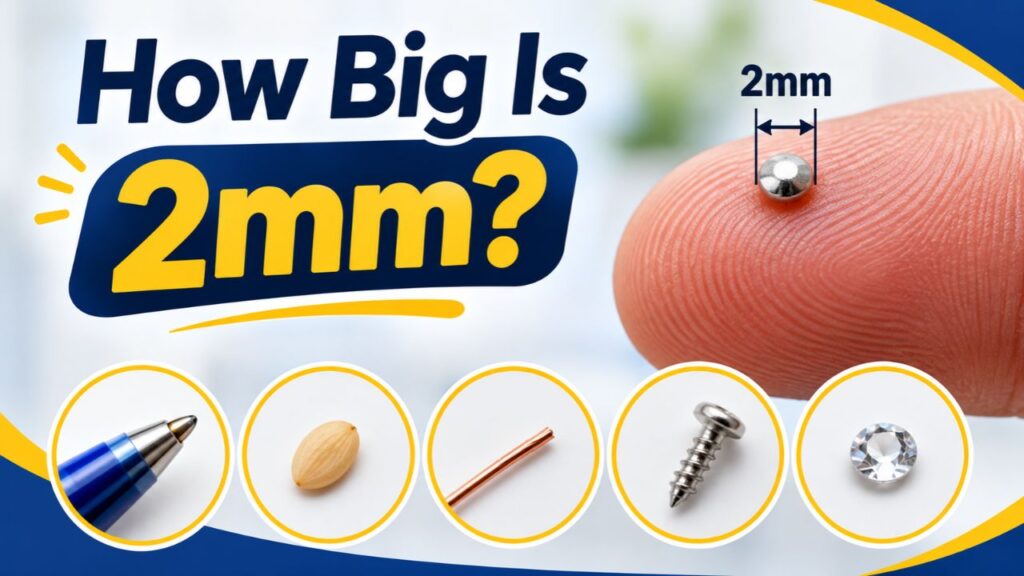
How small is 2mm? Two millimeters is a very small measurement that equals 0.2 cm, or about 0.0787 in. While it may be hard to imagine how tiny this length would appear, you can use objects you are familiar with to help you visualize what this measurement represents. Examples include a small bead, a thin piece of wire, a mustard seed, and even the thickness of a U.S. nickel.
This information about the measurement can be beneficial for many types of activities. Examples include buying items online, choosing jewelry, using small hardware components, taking measurements for crafting supplies, and comparing product specifications. Even though a difference of only 2mm may seem insignificant, it can make a big impact in terms of precision.
This article provides a simple way to determine the size of 2 millimeters using conversion tables, daily life references, ruler measurements, and comparisons to similar size objects.
Two millimeters is a unit of measure in the metric system. It can be used for describing the thickness, width, diameter, and length of small items.
A quick conversion table to show how much you can measure in different units.
| Measurement Unit | Equivalent of 2mm |
| Millimeters | 2mm |
| Centimeters | 0.2cm |
| Inches | 0.0787 inches |
| Meters | 0.002 meters |
| Micrometers | 2,000 µm |
| Feet | 0.00656 feet |
| Yards | 0.00219 yards |
| Fraction of an inch | Approximately 5/64 inch |
The most simple conversion for you to remember is that 10 mm equals 1 cm. Consequently, 2 mm is equal to one-fifth of a cm.
Also, when you convert millimeters to inches, you will divide the millimeter reading by 25.4. This will give you about 0.0787 inches.
The use of numbers alone can make it difficult for us to understand small units of measurement. By using common objects to compare these units of measurement to, it will be much simpler for us to visualize the concept.
There are numerous common household items and minor accessories with an approximate width of 2 mm. However, depending upon the type of material used to create the item, the manufacturer of the item, and how the item was designed, its true size may differ from this approximation.
| Everyday Object | Approximate Measurement | Comparison |
| US nickel thickness | 1.95mm | Almost equal to 2mm |
| Small mustard seed | 1–2mm | Similar diameter |
| Small jewelry bead | 2mm | Similar diameter |
| M2 screw | 2mm | Nominal shaft diameter |
| Thin craft foam | 2mm | Similar thickness |
| Small drill bit | 2mm | Similar diameter |
| Fine craft wire | 2mm | Similar diameter |
| Sesame seed | 2–3mm | Similar width or length |
| Tile spacer | 2mm | Similar gap width |
| Thick pencil lead | 2mm | Available in this diameter |
The examples above will provide some context regarding what 2mm looks like. In terms of size comparisons to items that are commonly available, the best match for the thickness of 2mm on this list is the US Nickel. It is estimated to be about 1.95 mm thick.
Seeds are an example of natural items that should be viewed as approximate measurements, since they can differ significantly in size.
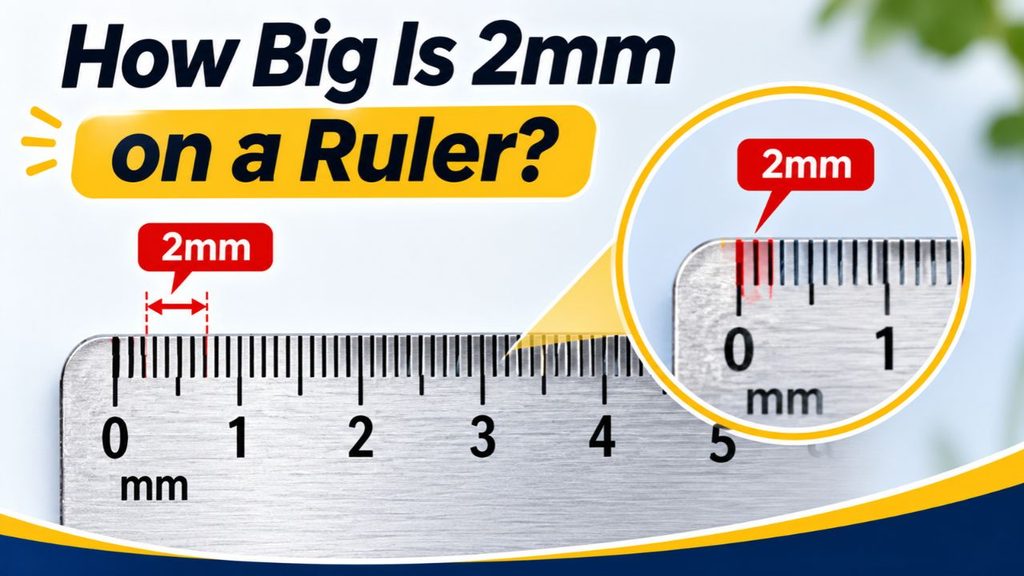
A ruler can be used as a simple way to help people understand the size of 2 mm. Many metric rulers have both centimeter markings and smaller millimeter markings in-between.
One centimeter contains 10 equally spaced millimeter divisions.
| Ruler Measurement | Number of Millimeters |
| First small division | 1mm |
| Second small division | 2mm |
| Third small division | 3mm |
| Fourth small division | 4mm |
| Fifth small division | 5mm |
| Sixth small division | 6mm |
| Seventh small division | 7mm |
| Eighth small division | 8mm |
| Ninth small division | 9mm |
| One centimeter | 10mm |
To measure 2mm, locate the zero mark on your ruler and count two small divisions toward the right.
Quick measurement reference
Illustrative ruler showing the first two millimeter divisions. Not to scale on every screen.
Always remember that the first small marking represents 1mm, while the second represents 2mm.
Here are some more practical examples that help you understand this measurement.
| Object | Dimension Being Compared | How It Relates to 2mm |
| Small jewelry bead | Diameter | Often available in 2mm sizes |
| M2 screw | Shaft diameter | Nominally 2mm |
| Drill bit | Diameter | Available in 2mm |
| Mustard seed | Diameter | Some varieties approach 2mm |
| Craft foam | Thickness | Commonly available in 2mm sheets |
| Tile spacer | Width | Available in 2mm spacing |
| Thin wire | Diameter | Can be manufactured at 2mm |
| Small gemstone | Diameter | Available in 2mm cuts |
| Mechanical pencil lead | Diameter | 2mm lead is available |
| Plastic spacer | Thickness | Commonly available in 2mm sizes |
Coins and credit cards are good examples of real-world objects that can be used to help you understand what small distances look like.
A US nickel is roughly 1.95 mm thick, which is nearly equal to 2 mm.
A typical bank card has a significantly thinner design than other types of cards and is typically about 0.76 millimeters thick.
| Object | Approximate Thickness | Comparison With 2mm |
| US nickel | 1.95mm | Almost equal |
| Standard bank card | 0.76mm | 2mm is about 2.6 times thicker |
| Two bank cards | 1.52mm | Thinner than 2mm |
| Three bank cards | 2.28mm | Slightly thicker than 2mm |
| Two US nickels | 3.90mm | Almost twice as thick |
This comparison demonstrates that 2 mm is significantly thicker than a single bank card, while being approximately the same thickness as a nickel.
Another way to get an idea of the size of 2mm is to compare with other items that are close by.
The slightest variation in size (even if only 1mm) will cause a visible difference when you are working on very small parts.
| Measurement | Centimeters | Inches | Comparison |
| 0.5mm | 0.05cm | 0.0197in | Very thin |
| 1mm | 0.1cm | 0.0394in | Half of 2mm |
| 1.5mm | 0.15cm | 0.0591in | Slightly smaller |
| 2mm | 0.2cm | 0.0787in | Reference measurement |
| 2.5mm | 0.25cm | 0.0984in | Slightly larger |
| 3mm | 0.3cm | 0.1181in | 50% larger |
| 5mm | 0.5cm | 0.1969in | 2.5 times larger |
| 10mm | 1cm | 0.3937in | Five times larger |
| 20mm | 2cm | 0.7874in | Ten times larger |
The measurement of 2mm is double the measurement of 1mm. While both are small, the distinction between them can be very significant when attempting to measure fragile items and tiny parts.
When choosing between 3mm and 2mm jewelry beads, drill bits or other mechanical parts, you will be making a choice that represents an increase of 50%. This is because 3mm is 1mm larger than 2mm.
2mm vs 5mm
Five millimeters is 2.5 times the size of two millimeters. Because it’s easier to see, five millimeter size is often used on smaller items like accessories and hardware.
One centimeter equals 10mm. Therefore, 2mm is only one-fifth of a centimeter.
The size of 20mm (or 2 cm) is ten times the size of 2mm. You should never get these two measurements mixed up when reviewing product specifications.
Indeed, 2mm is very small. It is less than 1/10th of an inch, and less than 1/2 of a cm.
On the other hand, the size of this object does not mean you cannot see it without using some form of optical aid. Many individuals are able to view a 2 mm object that is on a different colored surface than the object itself.
The challenge lies in knowing how large it actually is with no way to measure it.
| Question | Answer |
| Is 2mm small? | Yes, it is a very small measurement. |
| Can you see 2mm? | Yes, normally visible without magnification. |
| Is 2mm smaller than 1cm? | Yes, it is one-fifth of 1cm. |
| Is 2mm less than 1/8 inch? | Yes, 1/8 inch is approximately 3.175mm. |
| Is 2mm thicker than a bank card? | Yes, approximately 2.6 times thicker. |
| Can a ruler measure 2mm? | Yes, with a metric ruler. |
If you need to measure a small object, choosing the right measuring instrument is important.
Here are three simple methods.
| Measuring Tool | How It Works | Best Use |
| Metric ruler | Uses millimeter markings | Basic measurements |
| Digital caliper | Measures small dimensions digitally | Accurate diameter and thickness |
| Vernier caliper | Uses a graduated scale | Workshop and mechanical measurements |
Use a metric ruler: Position the object next to the “0” line on the ruler, and look at how far the other end of the object extends. Ensure that the ruler is properly oriented.
Open the jaws of the digital caliper, place the item you are measuring into those jaws, and lightly squeeze those jaws closed. The digital readout of the caliper will give you your measurement.
Utilize a vernier caliper to find the dimensions of an item. Place the item in the space created by the measuring jaws of the caliper. Then, use both the main scale on the caliper and the vernier scale to determine how long, wide, or tall the item is.
In most cases, for professional work, it is better to use digital or vernier calipers rather than a standard ruler.
Although it is a small dimension, 2mm is used in many industries and everyday activities.
| Industry or Application | Use of 2mm |
| Jewelry making | Small beads, chains, and gemstones |
| Electronics | Small screws and component spacing |
| Construction | Tile gaps and spacers |
| Craft projects | Foam sheets and decorative materials |
| Engineering | Small mechanical components |
| Woodworking | Small holes and material thickness |
| 3D printing | Wall thickness and design dimensions |
| Fashion | Small accessories and decorative details |
A measurement as little as 2mm may make a difference in whether or not two parts will align correctly. A tiny change in measurement can have a major effect on the ultimate outcome.
In some instances, people mistake millimeters for centimeters. Also in other instances, they will use common household items to make precise measurements. Both of these errors could result in inaccurate measurements.
| Common Mistake | Correct Information |
| Confusing 2mm with 2cm | 2cm equals 20mm. |
| Thinking 2mm equals 1/8 inch | 1/8 inch equals approximately 3.175mm. |
| Assuming every seed is 2mm | Seed sizes vary naturally. |
| Confusing diameter with thickness | These describe different dimensions. |
| Measuring from the ruler’s physical edge | Start from the zero marking. |
| Trusting screen measurements | Screen sizes and zoom levels vary. |
For accurate work, always use a proper measuring instrument instead of relying only on visual comparisons.
Two millimeters equals approximately 0.0787 inches. It is slightly smaller than 5/64 inch.
There are 0.2 centimeters in 2mm. Since 1 centimeter equals 10 millimeters, divide 2 by 10.
Yes. One-sixteenth of an inch equals approximately 1.5875mm, which is smaller than 2mm.
Yes, 2mm is generally visible without a magnifying glass. However, accurately estimating its dimensions can be difficult.
A US nickel is approximately 1.95mm thick, making it an excellent comparison.
Comparing 2mm to common everyday items makes understanding how large 2mm can be. A 2mm measurement equals.2cm, about.0787 inches, and is very similar in thickness to a standard US nickel.
Knowing this tiny measurement will help you make more informed decisions when choosing the correct size of hardware, working on DIY projects, checking product specifications, or even measuring jewelry. You can quickly get a general idea of what the measurement looks like by using a metric ruler, or comparing it to a nickel. If you need a more precise measurement than either of those can provide, then using digital calipers is probably the best way to go.
Also Read: How Big Is 100 Acres? | What Weight Is 300 Grams? | How Long Is a Yard?