 11
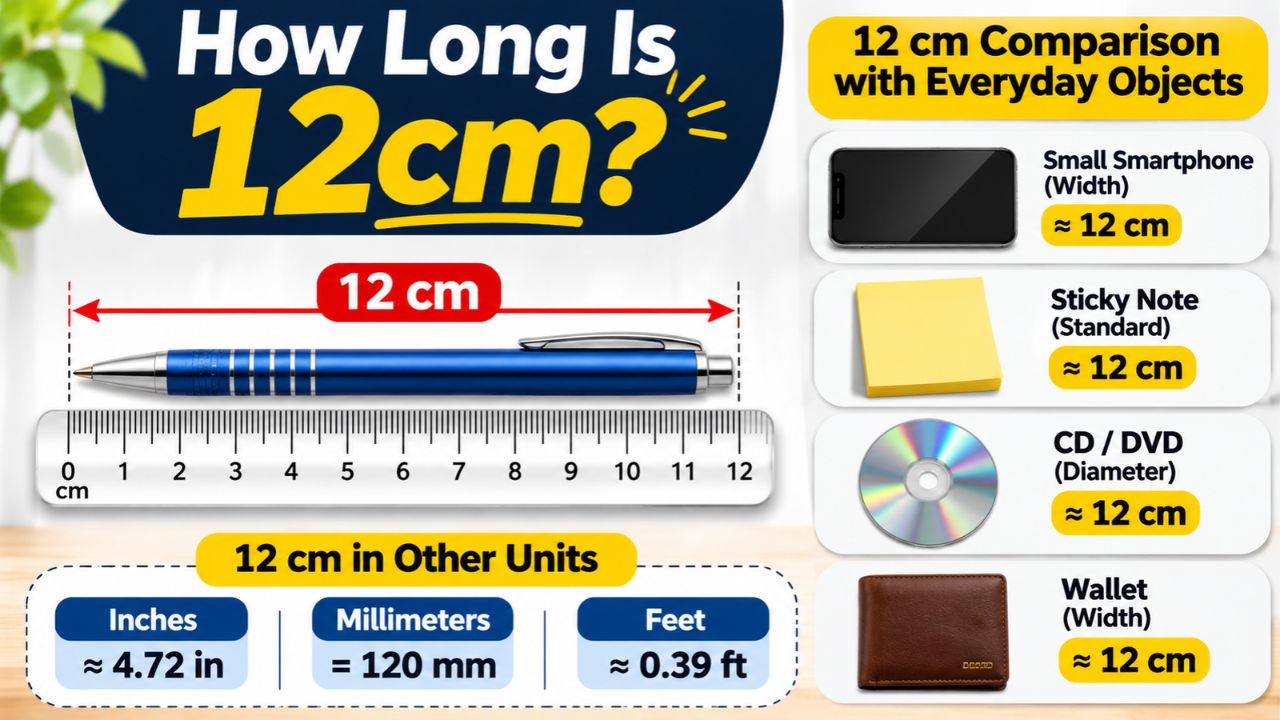
When you have a better understanding of what the unit of measurement means by comparing it to common items from daily life, such as products that you purchase, items of clothing that you wear, accessories that you use on a regular basis, or products that you look for online, then you can understand how to apply the knowledge of “how long is 12cm” in multiple ways.
A twelve-centimeter measurement may seem like a little amount, however, it does not have the appearance of being as small as you may think. Twelve centimeters are close to the size of the diameter of a standard-sized compact disc. Also, many common items in households are about twelve centimeters tall.
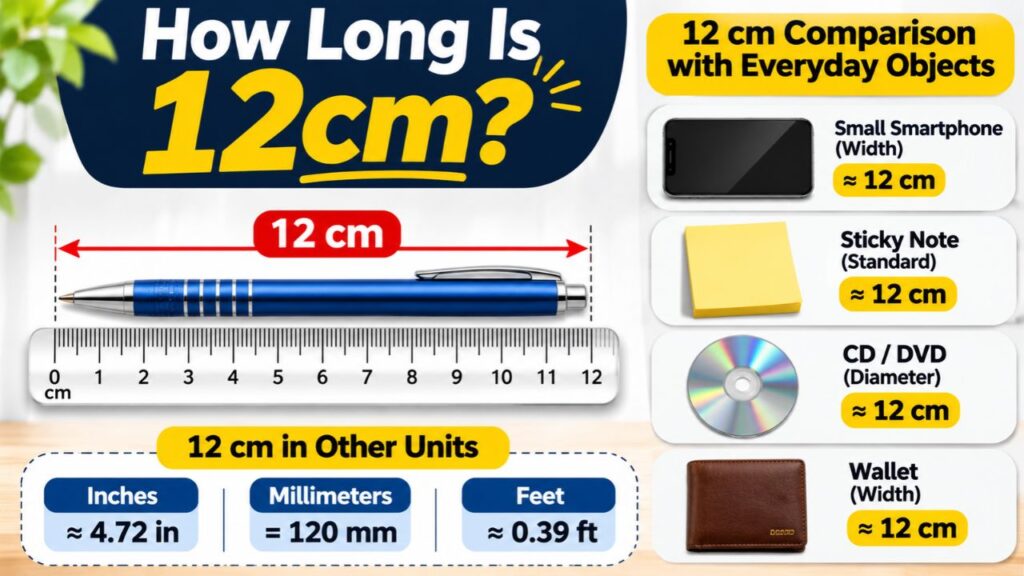
12 centimeters (cm) is a standard unit of length used in the metric system of measurement. This measurement equates to 120 millimeters and is slightly smaller than five inches.
To help visualize the scale of this item, imagine a straight line drawn from 0 cm to the 12 cm point on a standard ruler. The length of this line is reasonable enough to be held easily in either hand. This length is typical for measuring the sizes of many different types of household accessories, stationary items, electronics parts, and personal items.
What 12cm appears as will vary based upon the item being measured. A 12cm measurement for the length of an object would look very different than if it was 12cm in diameter, and equally different than if it was 12cm in height. It is therefore crucial to know which dimension of the object the measurement refers to; length, width, height, or diameter.
Also Read: How Big Is 100 Acres? | What Weight Is 300 Grams? | How Long Is a Yard?
Two common types of measurements are centimeters and inches. Most of the world (including India) uses centimeters, whereas many products manufactured in the U.S., and the U.S. itself, use inches.
To convert centimetres into inches, divide the centimetre measurement by 2.54.
12 ÷ 2.54 = 4.72 inches
Therefore, 12cm is approximately 4.72 inches long.
So, twelve centimeters (12 cm) is slightly less than five inches (5 in). For those of us who typically use centimeters to measure things, converting from inches to centimeters can be very helpful when we’re trying to figure out what something looks like based on its description.
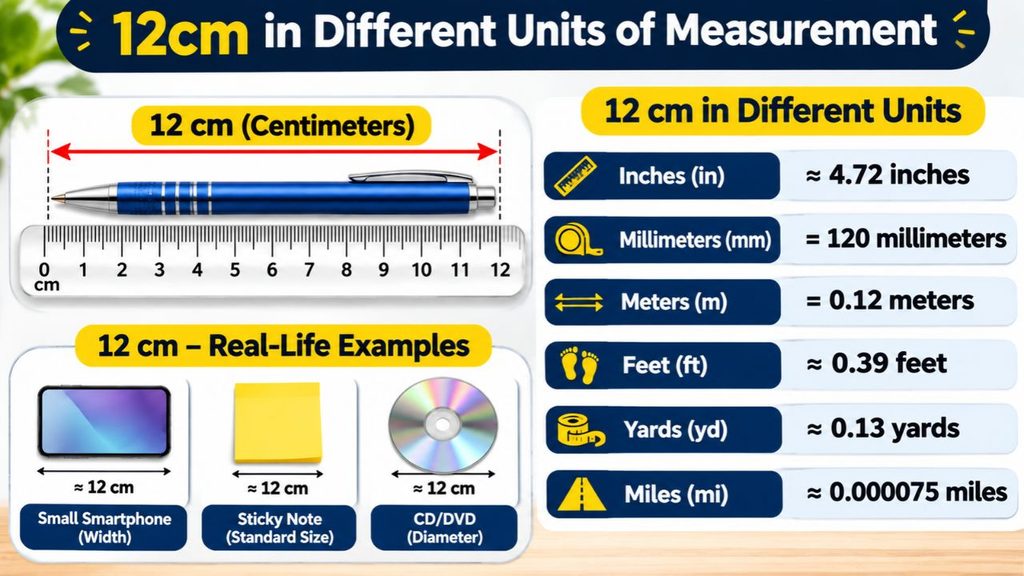
Several unit options are available for expressing the same measurement depending on which measuring system is used. By converting 12cm into other types of units, you can easily understand product specifications, sizes, and measurements.
| Measurement Unit | Equivalent Value |
| Centimetres | 12cm |
| Millimetres | 120mm |
| Metres | 0.12m |
| Inches | 4.72 inches |
| Feet | 0.394 feet |
| Yards | 0.131 yards |
In general, millimetres and inches are among the most commonly used units of measurement in our daily lives. Millimetres are used to measure the length of small objects, and inches allow us to compare the size of products from around the world.
When visualizing a measurement, using comparisons with everyday objects makes it easier to comprehend. Not all measurements require the use of an actual measuring tool to estimate length.
There are a few items in our daily lives that are approximately 12 cm long. The length of these items may vary based upon the manufacturer of the item, the way the item is designed, and what type of item it is.
A typical compact disc is a great example of a 12cm measurement. This type of disc has a diameter that measures about 12cm, and therefore can be used as a good visualization tool for this length.
In order to understand what 12cm means, take a look at the width of an old music CD/DVD that you may have in your house. The measurement will give you a real-world example of how far 12cm is.
The standard size of most soda/beverage cans is an additional example of a common item used for comparison. The average height of most standard soda/beverage cans is about 12 cm. However, depending upon the volume of the can and who manufactured it, there may be some differences in overall measurements.
To understand the approximate size of 12 cm, place a can on a flat surface such as a table and look at how tall it is. This is a very simple method that does not require the use of any measuring devices.
A common stick of butter is about 12 cm long. This can serve as a simple, easily accessible reference for many everyday tasks.
Butter packages differ across nations, therefore there may be differences in the size of each stick of butter. Although, a regular stick of butter is a close equivalent to a 12 centimeter measurement.
Many small computer mice have dimensions of about 10-12 cm. The size of these types of computer mice will vary based on how they are designed, what shape they are, and why they are going to be used.
If you are using a compact wireless mouse, find out what size (length) it is by measuring it from the tip of the front button to the rear. This will give you a better understanding of what 12cm would look like in daily use.
Small wallets that fold may be about 12cm long. Most small wallets were developed with the idea of fitting into pockets or smaller bags.
While there are many variations in wallet dimensions, they generally give an idea of how much space you have available to store items.
The length of some common household light bulbs is typically between 11-12 centimeters (cm) from the top of the bulb to the bottom of the base.
A standard LED bulb may also be used as a source for comparison.
The smaller of the two coffee mugs will typically be less than 12 cm tall. Most of them are usually between 9 and 10 cm in height. By comparing the taller of the two coffee mugs with the shorter of the two coffee mugs, you can get an idea of how much taller the first coffee mug is compared to the second coffee mug.
An approximate visual image of the desired length would be what you get when you increase the height of a small mug by 2-3 cm.
Pocket sized notebooks are available in various sizes. A few have a width that is near 12 centimeters, so these can be used as a reference to help you visualize what 12 centimeters looks like.
If you frequently have a small notebook with you, look at either the shorter or longer edge of the notebook and find out which one of those edges has a length that is closer to 12 centimeters.
The average grapefruit (medium-sized) will generally be between 10-13 cm in width. If you would like to visualize what that means, try imagining a grapefruit that is about 12 cm in width.
You can place the fruit on a flat surface and use a ruler to measure the distance at the widest point of the fruit. This will help you find the size of the fruit.
Sometimes small containers for storing accessories, jewelry, stationary and other household products can be about 12 cm long.
You will need to verify what dimension of the object you are measuring because they have varying lengths, widths and heights. This illustration is particularly beneficial when designing space for storage.
Compact electronic gadgets are typically less than 12 cm long. These can range from smaller electronic accessories that are portable to remotes and other handheld electronics.
The size of each of these products will vary depending upon what it is, however they do serve as an easily recognizable frame of reference for understanding measurements within that range.
You do not have to use a measuring tape to find the estimated distance of a relatively short distance. You can use any of the many different ways to estimate distances with common household items.
Using a compact disc (CD): A typical CD is approximately 12 cm in diameter, which makes it an ideal reference.
Compare it with a beverage can: A standard can is close to 12cm in height.
You can use your finger as a measuring tool to estimate small distances, however, since everyone’s hand size is different, so will be their finger measurements.
Using a notebook, verify if the length of one edge of a smaller-sized notebook is about 12 cm.
Create a reference length on a sheet of paper by folding it, or marking it, and use that reference length to measure against the desired length.
These methods provide general estimates. For precise measurements, utilize an accurate measuring device.
When you have a ruler or measuring tape, it is easy to measure 12 cm. Follow the instructions below to make sure you get the right measurement.
To begin, lay the measuring tape or ruler on a level surface. Locate the “0” point on the measuring device and line it up with the initial boundary of your item.
Now, stretch out the ruler until it reaches the 12 cm mark. Verify that the end of the item aligns with this mark.
When measuring a circular object, find where the object is the widest, this will be your starting point for measuring the diameter. When measuring a rectangle-shaped object, start by finding the required edge of the object and then use a measuring device to go to the opposite edge.
Keep in mind that one centimeter is equal to 10 smaller millimeter sections. As such, 12 centimeters will contain 120 millimeters.
Rulers usually have a blank space (margin) at one end before the first measurement line. Therefore, it is important to begin your measurements at “0” rather than the actual physical tip of the ruler.
Whether 12cm is considered long or short depends on the object being measured.
A twelve centimeter measurement is short for a pencil, ruler, or smaller electronics accessory. On the other hand, twelve centimeters is long enough for jewellery, smaller storage boxes, and compact home appliances.
The size of a twelve-centimeter (12 cm) pendant on a necklace may seem very large; however, the size of a twelve-centimeter (12 cm) storage container would likely appear to be small.
In day-to-day life, this measurement is typically used to measure small objects and accessories, not large household items or furniture.
Although 12cm and 5 inches are close in size, there is a slight difference in their dimensions.
Five inches equals 12.7cm, which means it is 0.7cm longer than 12cm.
| Measurement | Equivalent |
| 12cm | 4.72 inches |
| 5 inches | 12.7cm |
| Difference | 0.7cm |
The variations in size are slight; however, these differences could be significant for product measurements, material preparation, and other activities requiring exact dimensional accuracy.
The 12cm measurement is common in many daily life activities. By being aware of this measurement you will be better able to shop, organize household items, and complete small DIY tasks.
Shopping online: Product descriptions frequently list dimensions in centimeters. Being aware of how long 12 cm is assists you in determining if an item such as an accessory, a container, or a device would fit your needs.
Home Organization – Small Storage Boxes, Organizers, and Decorative Accessories Could be Approximately 12 cm.
Arts and crafts: Often times when making items such as cutting paper, preparing decorations, and making handmade products, it is necessary to make sure that the measurements are accurate in centimeters.
Stationery: These are items like small notebooks, pencils, pencil accessories, and other types of office supplies. They may be shaped with sides that measure about 12 cm.
Electronics: Compact electronics items may use centimeters when describing the dimensions of their length, width or height.
When you have an understanding of measurements, it will make daily decisions easier. Knowing what 12cm looks like allows you to be more confident when comparing products and avoiding buying products that are either too big or too small for your purposes.
For example, when buying a small organizer online, you may know that the product description states the length of the organizer is 12 cm. However, without having some idea of how large it will be, it can be difficult to picture what the item looks like in person. By comparing the size of the organizer to something like a compact disc or even a can of soda, you can get a clearer picture of how big the organizer is prior to making your purchase.
Likewise, measuring tools can help you prepare your craft projects, check your luggage accessories, arrange small items, and select product for your home.
The ability to understand the concept of centimeters can help make converting measurements to either inches or millimeters simple when required.
People will often make errors when estimating measurement without appropriate instrumentation. These errors may lead to inaccurate product dimensions or misleading comparisons.
Confusing centimetres with inches: Twelve inches is much longer than 12cm.
Starting from the wrong point: Always begin measuring from the zero mark.
In the case of two identical products, they can be manufactured with different measurements, assuming that each product is made to the same size.
In disregard of the way we measure: Length, Width, Height, and Diameter are all ways to describe different parts of an object.
On Visual Estimation Alone: Familiar Objects offer an Approximation of Measurement, not a Guarantee.
To prevent such errors, utilize a straight edge (ruler) or a measuring device (tape measure) when you require an accurate measurement.
12cm is approximately 4.72 inches. It is slightly shorter than 5 inches, making it easy to visualize using a standard ruler.
No, 12cm is slightly smaller than 5 inches. Five inches equals 12.7cm, which is 0.7cm longer.
You can estimate 12cm by comparing it with familiar objects, such as a compact disc’s diameter or a standard soda can’s height. However, these comparisons are approximate.
There are 120 millimeters in 12 centimeters. Since one centimeter equals 10 millimeters, multiplying 12 by 10 gives 120mm.
12cm is a relatively small measurement. It is slightly less than 5 inches and is commonly used to describe compact household items, accessories, and small products.
The easiest way to understand what a length of 12 cm looks like is by comparing it to common items. A length of 12 cm is equivalent to 120 mm and is slightly less than 5 inches (about 4.72 inches).
The most common example of an everyday object with similar dimensions to a standard compact disc is the average beverage can. Other examples include various types of small household items. This dimension may be estimated by using a person’s hand, a notebook, or other typical everyday objects.
This measurement will assist you in making improved choices when shopping online, determining the dimensions of household items, or undertaking a do-it-yourself project. While everyday objects provide some basis for comparison, it is best to rely upon a ruler or measuring tape when precision is required.
Also Read: Cologne Bottle Sizes | How Big Is 2mm? | Alcohol Bottle Sizes