 11
11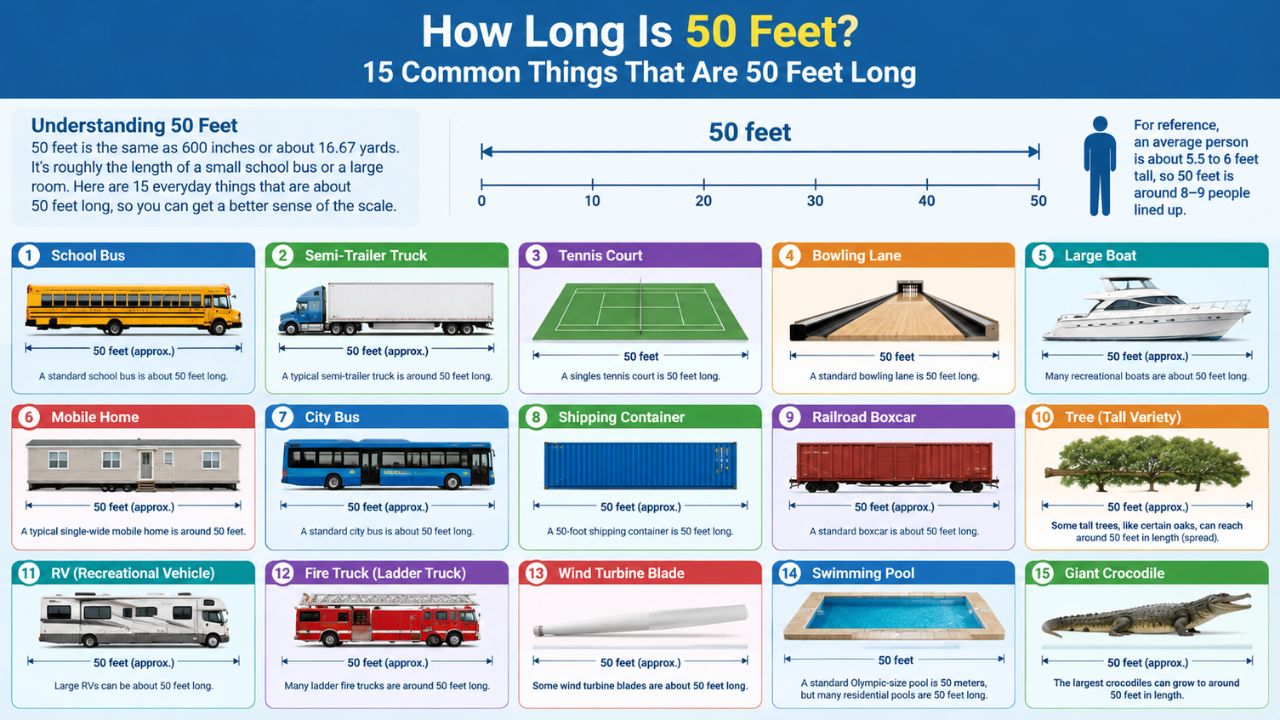
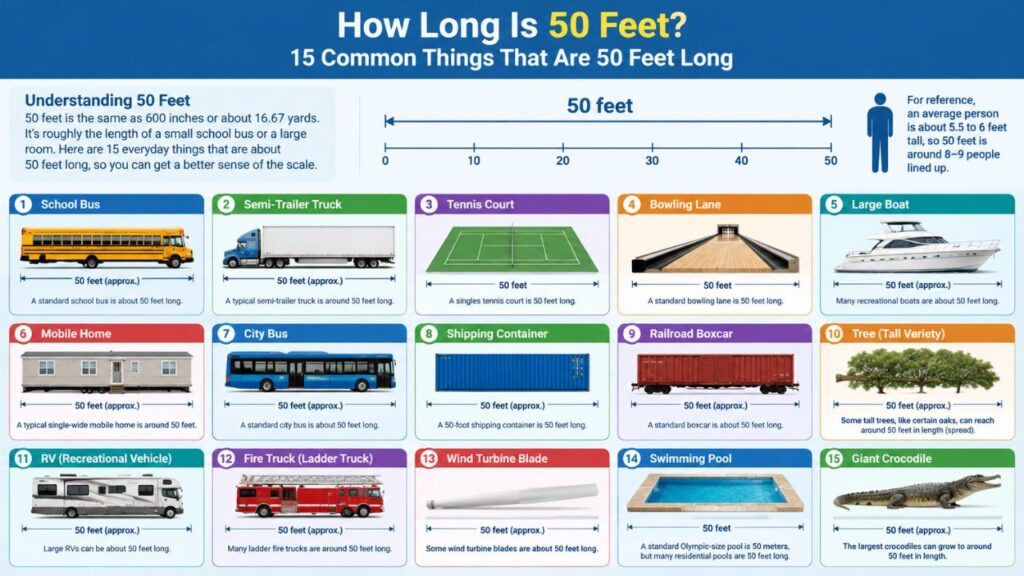
Do you know how long 50 feet is? Fifty feet is a long distance that can be hard to picture unless you compare it to things you already know. If you’re going to measure a building, plan a home improvement project, estimate a distance, or just learn about measurements, seeing what 50 feet looks like using common everyday examples will help you better understand it.
Fifty feet has an equivalent value of six hundred inches, sixteen point six seven yards, and about fifteen point two four meters. Fifty feet is a common unit of measurement when trying to understand how long cars, swimming pools, large rooms and other buildings are.
In this article, we’ll tell you what 50 feet is in other units of measure, as well as show you 15 examples of things that are about 50 feet long so you can get an idea of just how long that is.
It would be helpful to understand how 50 feet relates to other measurement units before comparing 50 feet to common everyday items.
| Measurement Unit | Equivalent to 50 Feet |
| Feet | 50 feet |
| Inches | 600 inches |
| Yards | 16.67 yards |
| Meters | 15.24 meters |
| Centimeters | 1,524 centimeters |
| Millimeters | 15,240 millimeters |
The chart indicates that 50 feet is equivalent to about 15.24 meters. This conversion is especially helpful when working with measurements in countries like India, which typically measure length using meters and centimeters.
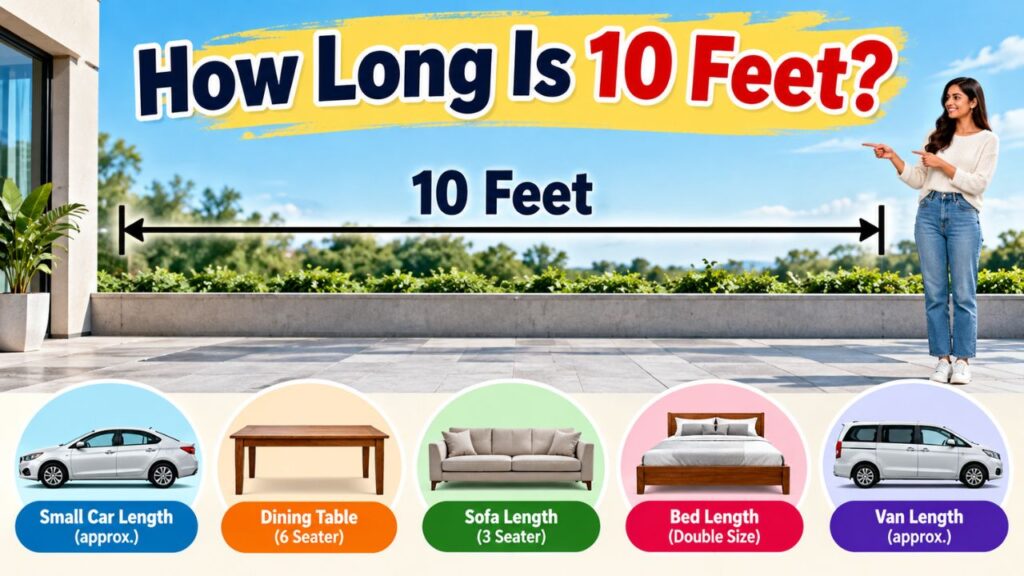
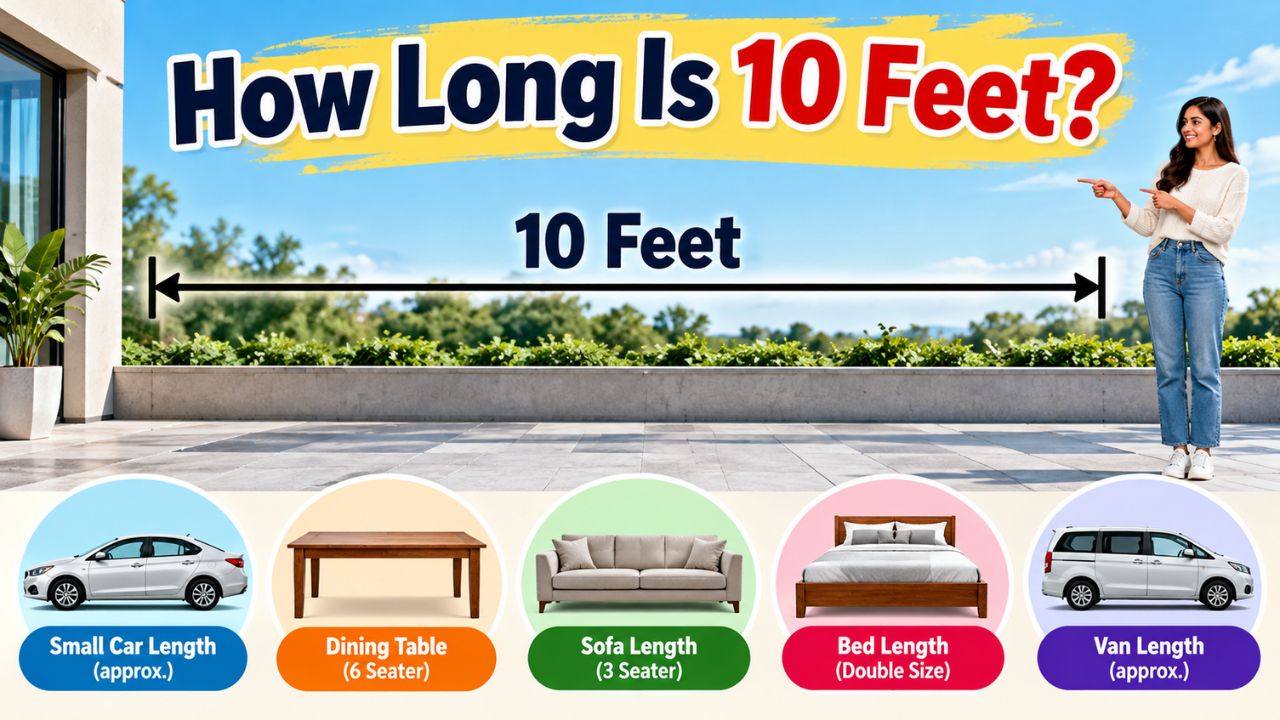
Imagine using five ten foot items and laying them down end to end. When you do so, you’ll have created a total length of fifty feet.
A different method of understanding this distance is to walk in a straight line for about 15.24 m. How many steps you take will be based upon how long each step is.
As an example, if you typically take a step that is 2.5 feet long then it will take about 20 of those same steps to go 50 feet. It is an easy method to figure out how far away something is from where you are standing without having to use a tape measure.
These examples will help you visualize what 50 feet looks like using common objects/structures. These are average sizes (dimensions), but they may differ based upon the type/design/model, and/or where it is located.
Mid-sized cars are usually about 14 to 16 feet in length. When you put three of these cars together end to end, they will stretch from around 42 to 48 feet. This is very close to 50 feet.
A more clear comparison can be imagined by thinking of three cars, which are approximately 16.7 feet long each. When combined, these three cars will have a total length of approximately 50 feet.
The size of a typical commercial tractor-trailer combination is generally between 50 and 70 feet long. However, there may be many types of commercial vehicles that will exceed these measurements.
Thinking about a truck with its trailer being parked in a straight line will help you visualize the same type of distance as used in the real world.
The size of some residential and recreational swimming pools is about 50 feet. Swimming pools are available in a wide variety of shapes and sizes. Competitive pools may be much larger than this.
A 50 foot pool allows you to directly see what this length looks like.
The height of a utility pole varies from 30 feet to many times that amount. Some utility poles can be even higher depending on the application. The total distance of a utility pole if placed on its side is different from the total height of a utility pole.
Imagine five poles, all measuring ten feet in length, lined up next to one another. Their total length would be precisely fifty feet.
The length of an official NBA basketball court is 94 feet. The midpoint of this distance is 47 feet, just three feet short of 50 feet.
This means that a basketball court is about half as long as the 50 foot distance you want to measure.
The area of a garden with a 50 foot dimension on at least one of its sides is a good illustration of what constitutes a “50 foot” space. A rectangular garden which is 50 feet by 20 feet will have an area of 1000 square feet.
When making plans for landscaping, planting trees, and placing furniture outside, this comparison will be extremely beneficial.
A standard ten-foot ladder offers a simple guide to understanding much longer distances. If five ten-foot ladders were put together end-to-end on the floor, they would measure fifty feet.
The above is not a recommendation for connecting or using ladders in the manner described, but rather a comparison based on mathematics.
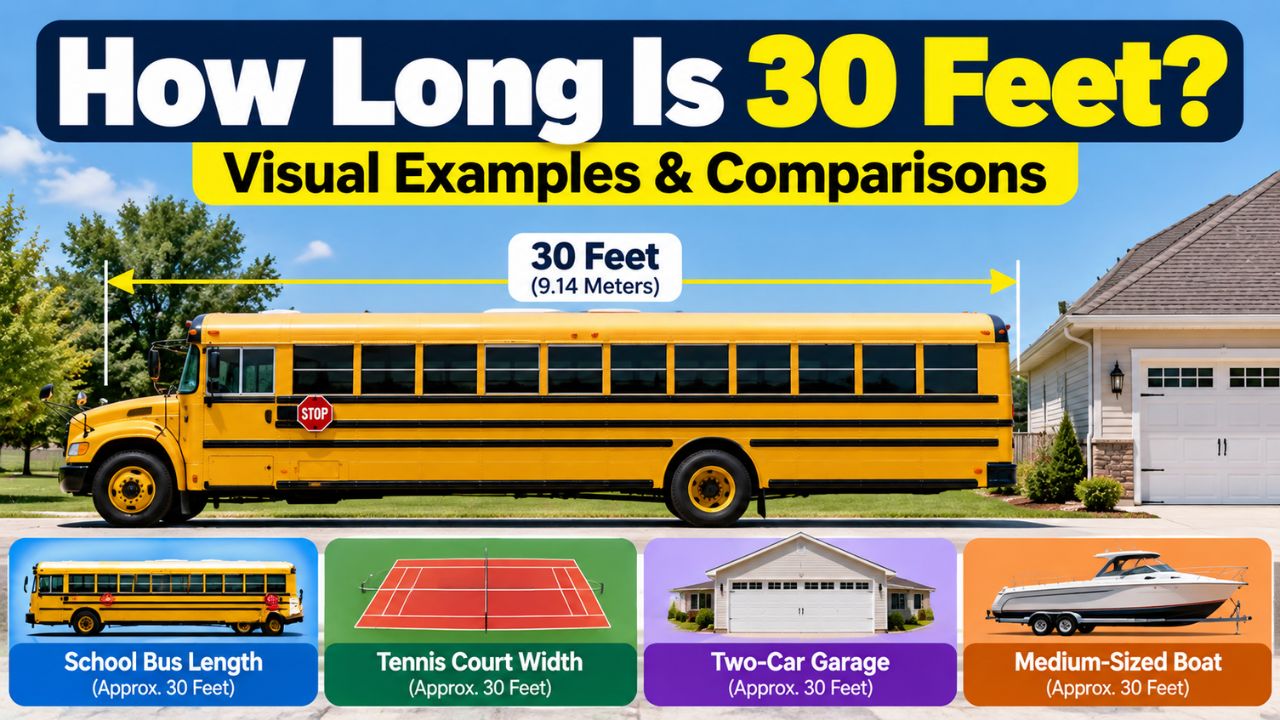
A typical school bus can be from about 35 feet to about 45 feet in length, based on the size and model of the bus. Thus, a 50 foot distance would be longer than most school buses.
I’m imagining a bus that is 40 feet long and has an additional 10 feet of clear area directly behind it. This means the entire distance from front to back of this scenario will be 50 feet.
The front of many smaller shops, offices, and commercial buildings are approximately fifty feet wide. While actual building size varies, this serves as an appropriate representation of what can be expected regarding architectural measurements.
A 50-foot frontage allows for several shop frontages, storefronts, or other commercial uses.
Most pickup trucks are about 17 to 20 feet long. As such, two or three trucks will take up a good deal of the 50 feet.
The same distance can be demonstrated with 5 vehicles, which are each 10 feet long. If these 5 vehicles were placed end-to-end, the total length of the line of vehicles would equal 50 feet.
In other words, you have ten small trees spaced approximately five feet apart in a straight line. If you were to measure the total length of this line from the first tree to the last tree, it would be around 45 feet because you would have nine equally spaced intervals.
If you have a row of ten 5 foot interval spacing, the length of the row will be 50 feet. It can be useful to know how long each row will be in order to plan your garden layout and space out your trees..
The majority of living rooms do not exceed 50 feet in length; however, there are many larger halls and open-concept indoor areas which have the potential to be near this size.
Now, imagine a large area with a dimension of 30 feet. This large area connects with a second, larger area having a dimension of 20 feet. These two areas combine to make a single area of 50 feet.
A 10-foot long measuring tape or a 10-foot long piece of string with marks on it can be used to show how long 50 feet is. If you use 5 straight lines of 10 feet each, they will total 50 feet.
For real-life applications, you should use either an appropriate measurement device (tape or wheel) to accurately indicate each portion of an area that is being measured.
A 50 foot portion of a fence can typically be located within residential yards, gardens, and along property lines. The number of panels used to complete the portion of the fence will depend upon how wide each panel is.
For example, if you were to install 10 panels that were each five feet wide, you would have a total of fifty feet of coverage when you put them all in a single row with no other spaces between them
Imagine that you have placed 25 tiles (each tile having a length of 2 feet in the same direction as the row) side-by-side; therefore, the total length of these tiles will equal exactly 50 feet.
In order to estimate how much material (such as flooring), walk ways, and/or any other project that requires a long straight line of measurement will cost you.
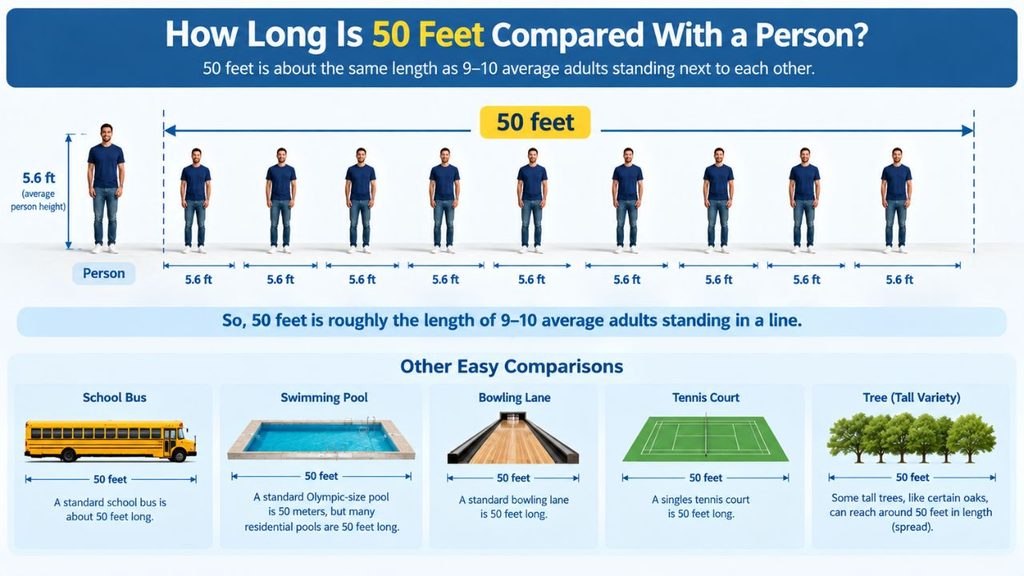
The typical adult is about five to six feet tall, however, there can be great variability in an individual’s height. If a person was five feet tall and had ten people of the same height stand on each other’s shoulders, then the total height would be 50 feet.
Only visual comparison is possible since a person’s height is vertical measurement, but the distance of 50 feet is usually horizontal measurement.
A real world application for this concept would be an adult who is six feet tall and stands next to a fifty foot long piece of rope. The rope would extend past the adult’s head by more than eight times his own height.
Fifty feet is equal to approximately 15.24 meters.
To convert feet into meters, multiply the measurement in feet by 0.3048.
Formula:
Meters = Feet × 0.3048
Therefore:
50 × 0.3048 = 15.24 meters
The conversion can be used in many different areas such as construction, landscaping, sports, etc., where measurements are taken with the metric system.
There are 12 inches per foot. If you want to find how many inches are in 50 feet, you will need to multiply 50 times 12.
50 × 12 = 600 inches.
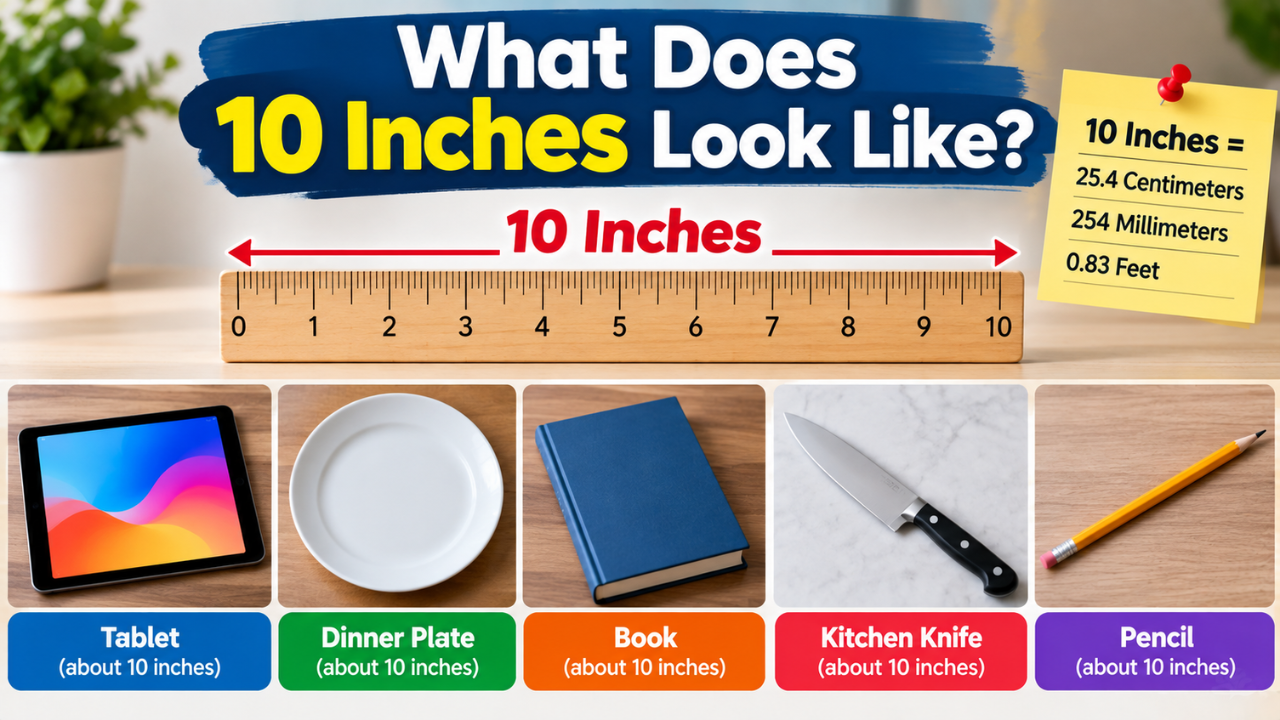
So 50 ft. is equivalent to 600 in. The use of this conversion is helpful when measuring details, working with wood and comparing measurements stated in inches.
How long it takes to go 50 feet depends on how fast you walk and how far each step goes. A typical walking person would most likely get there in about 10-15 seconds.
A person who walks quickly can complete the same route as a slower walker but with less time spent. On the other hand, someone who walks at a slower rate will require more time to walk that same route. Other factors that can influence the amount of time needed to walk a given route include: obstacles, bends in the road, and uneven surfaces.
A more precise method for measuring distance would be using a measuring tape or measuring wheel instead of just counting your steps.
Knowing how long 50 feet is can be helpful in several everyday situations:
The use of visual comparisons can be helpful for rough estimations; however, precise measurements should be taken when making decisions about safety, construction, property boundaries, or material costs..
Fifty feet is a moderate distance in everyday settings. It is longer than many rooms and cars, but shorter than a full basketball court.
Fifty feet equals 15.24 meters, so it is slightly longer than 15 meters.
There are approximately 16.67 yards in 50 feet because one yard equals 3 feet.
If your average step length is 2.5 feet, it takes approximately 20 steps to walk 50 feet. Your actual step count may vary.
Yes. You can use familiar distances, such as half of a standard basketball court, or estimate the length using repeated 10-foot sections. These methods provide approximations rather than guaranteed measurements.
The length of 50 feet will be a lot simpler to comprehend if you think about it in relation to common things and areas. Fifty feet is equivalent to 600 inches, 16.67 yards, or about 15.24 meters.
A few common items that can assist you with visualizing this distance include: a swimming pool; commercial building frontage; and a series of fence panels. While these comparisons will assist you in estimating the length of something, please use a precise measuring instrument if you need accurate measurements.
Once you know what these examples look like, it will be easier for you to estimate a 50-foot distance in your house, yard, office, or outside.
Also Read: How Long Is 13 Inches | How Big Is 10 cm | 8 oz Bag of Chips Size