
 11
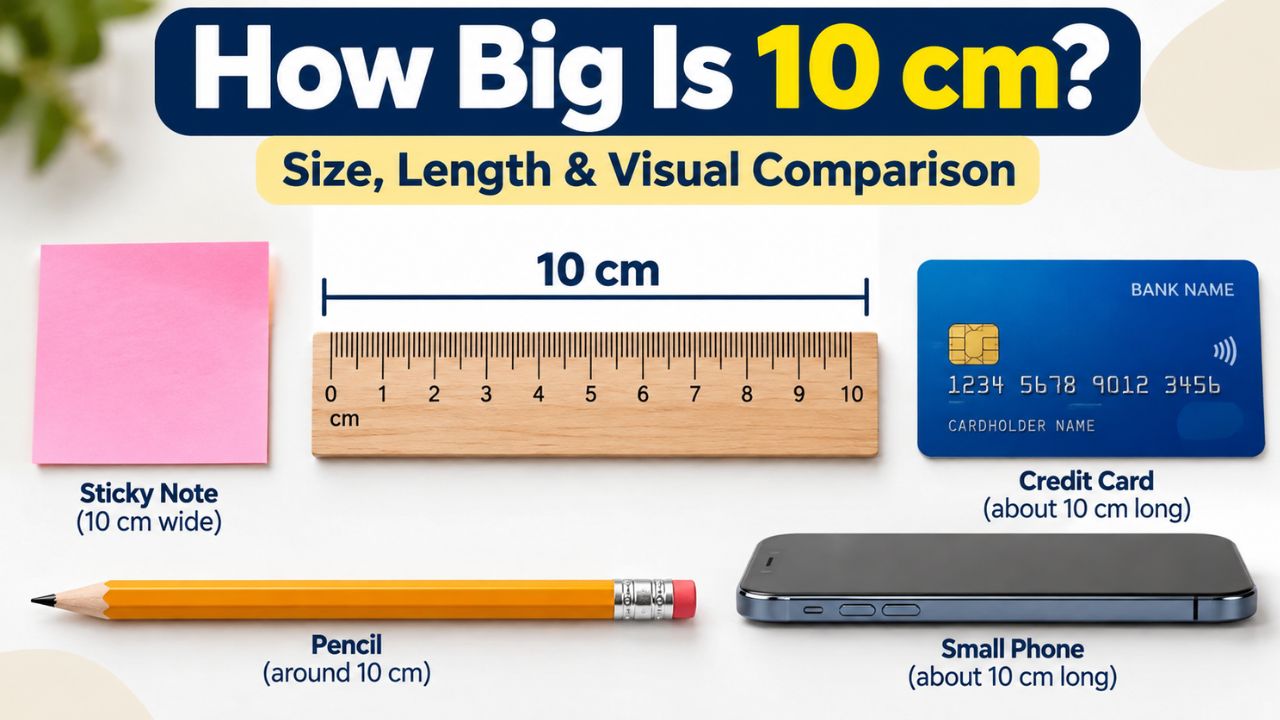
So, how big is 10 centimeters and what does that actually look like in real life? Numbers may be tough to visualise sometimes when you see only the numbers. 10 cm sounds very small, but a couple of common references help to make the numbers easier to understand.
Ten-centimeter measurement is an engaging activity you come across in daily life when crafting, shopping, school projects, cooking DIY jobs and of course measuring other things around the house! In this guide, we will break down what exactly 10 cm is, convert it to other measurement units, and provide comparisons to everyday household and personal items.
So, how-big-is-10-cm? 10 cm = 100 mm = 3.94 in = approx. 0.328 ft
If you think of a standard ruler, the simplest way to visualize 10 centimetres is to look at the first 10 cm on it. Gonna measure it out is just under 4in long
As a very rough visualization, think of drawing a straight line from the 0 mark on a ruler to the 10 cm mark. That distance is, in fact, exactly 10 cm.
10 cm is small (but, compared to everyday objects, not undetectably so).
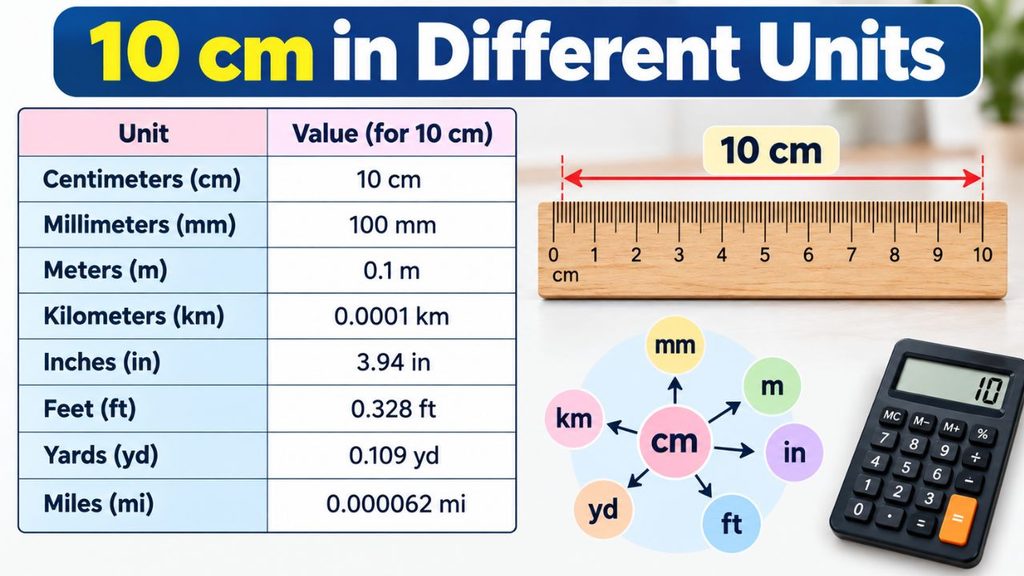
One way to think about how-big-is-10-cm can be made easier by coming to grips with different systems of measurement.
| Measurement Unit | Equivalent of 10 cm |
| Millimeters | 100 mm |
| Centimeters | 10 cm |
| Inches | 3.94 inches |
| Feet | 0.328 feet |
| Meters | 0.10 meter |
| Yards | 0.109 yards |
For everyday comparisons the most useful conversion is 10 cm ≈ 3.94 inches. So 10 cm is pretty much 4 inches.
Without a ruler around, you can still get a decent sense of scale. Imagine something that measures a little less than four inches long. This covers a lot of small household objects.
You can also use your hand as a rough reference. Depending on the person, several fingers placed side by side have a width of up to 10 cm. This, however, is an estimate only as hand sizes do vary.
One other simple method is splitting a 20 cm ruler in half as well. Half of 20 cm is a whole ten-centimeter long.
Comparative size that most easily illustrates how-big-is-10-cm, one of many techniques to diagram it using common household and lifesize objects. These examples can help you cultivate a practical sense for the size.
An average pencil is more than 10 cm long, but a shorter piece of a pencil provides an appropriate visual comparison. That is a substantial part of an average pencil: ten centimeters.
Some of them can reach a width of 7–8 cm, and larger models are wider. That’s somewhat wider than the bodies of many phones, so Goodie has made it 10 centimeters wide.
It is 8.56 cm wide, the standard credit card size That makes 10 cm a bit longer than the short side of an average bank card.
Most TV remote controls are much longer than 10 cm. The 10 cm mark is more like a small fraction of their entire length and handy for estimating distances.
The typical toothbrush head is less than 10 cm long, but lumping multiple sections of your toothbrush together might give you a sense of this distance.
The small spoons are especially large in the 10 cm range overall. This measurement can actually vary based on the design and usage of a spoon
Another informative reference are the handle portions of small scissors. Some kids’ scissors (or craft scissors) have small handles near this size.
Small pocket notebooks come in different sizes, but some approaches around 10 as wide. Which makes a notebook a good visual comparator when thinking about the measurement.
A matchbox has a design with at least one in the 10 cm range. An example that is quite convenient since it is a common rectangular object facere.
Indeed some individually packaged chocolate bars have a length or width approaching 10cm. The precise physical size of bottles will vary according to the specific brand and packaging.
One of the most common everyday references is a ruler itself! Distance from 0 – 10 cm gives the perfect replication of it.
The compact pocket combs can be as small as 10 cm. That is, when you see a comb as small to compare it visually size.Dependency: dependency classes.
The USB plug itself is at least an order of magnitude smaller than 10 cm, but the connector and a few centimeters of cable provide a useful scale distance.
An artist paint brush (small) may have a handle that reaches or exceeds 10 cm in length. This visualization of this measurement is especially useful when working on craft projects.
There are small calculators that reach about 10 cm wide or high. While different in size, they are a common object for comparison.
Wallet dimensions vary considerably. Another is the compact wallets which are under 10cm tall, so at least we have another tangible reference.
Portable cosmetic products, small makeup cases or types of container could be approximately 10 cm across. They’re also easily comparable in size visually.
The standard bar of soap is approximately this size along at least one dimension although the exact length, width and thickness vary by product.
A line of small stationery items placed in serial arrangement can easily stretch to a distance of 10 cm. This is handy when you estimate measurements in the school or office work.
The printed photograph is typically a small section, one side near 10 cm long (depending on format). This provides an alternative easy way to picture the measurement.
Your hand should be your handy binaural scale when you need to conjecture something.
For most people, through a few fingers the distance can be about 10 cm or so. But this isn’t an absolute measurement because not all hands are created equal.
Unless you are talking about a hand span ruler, be sure to not just use your hand if accuracy is important.
If you have no ruler and are asked to estimate 10 cm, think of items that might help be used as reference.
An alternative is to approximate the width of a standard bank card. Since a bank card is 8.6cm, adding 1.4cm brings you about to 10cm!
Alternatively, we can imagine four inches since 10 cm works out to be just slightly less than four inches. It has a rough comparison if you know something that is around four inches long.
These methods are good for estimation, but should never be used instead of accurate measurement when accuracy is key.
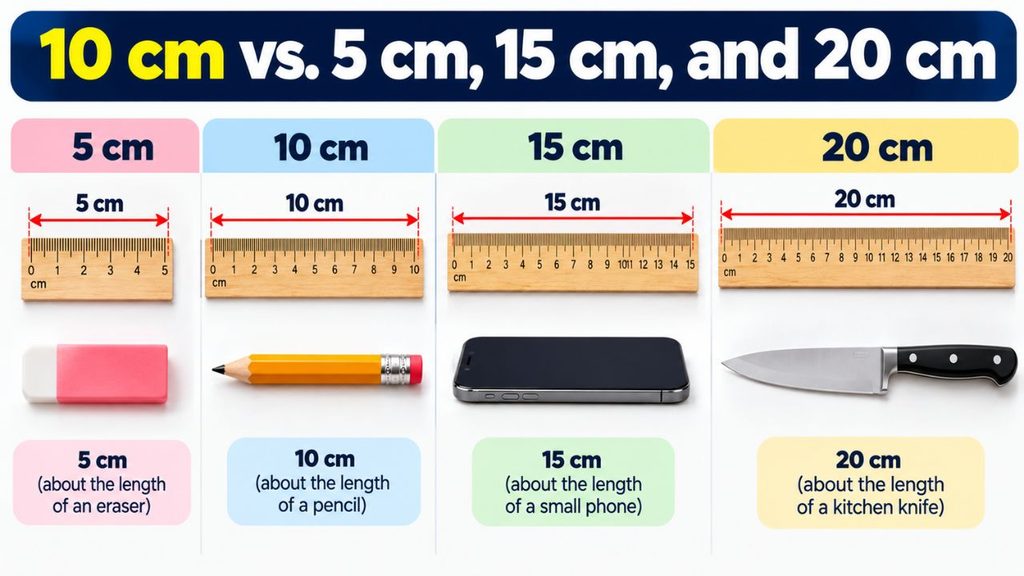
For example, how-big-is-10-cm can get much easier to read if we compare it to other nearby measurements.
So a straight line with length 20 cm for example has been exactly halved. So if you cut both sections in half, your halves would be 10 cm each.
It is helpful for children who are learning measuring, and also for people doing crafts or DIY.
10 cm seems either big, or small depending on what you are measuring.
Ten cm is a little short for a sheet of paper. But for a tiny e-skin component, 10 cm could well be mammoth. That tends to be small for complicated objects and perhaps more medium range for everyday objects.
Easily handled: a 10 cm can be held in the palm of your hand, placed in a pocket or store and transport. This is also a frequent measurement in household items and personal accessories.
In fact, being able to gauge the length 10 cm in physical space can help you in many practical situations! Students might require it for geometry, scientific research study jobs, or craft tasks. It can be used by designers when modelling small objects and DIY enthusiasts might need it to cut, space or for installations.
This also has its advantages when doing online shopping. Many product descriptions give measurements in cm, knowing how-big-is-10-cm means you can judge if the item you are purchasing will fit into an area.
A product might even be listed as 10 cm wide, and just like that – you can translate it to about four inches wide.
Visualising measurements is time saving. Instead of converting centimeters to inches constantly or looking for a ruler, you can build an internal benchmark using things that are already familiar;
If you get good at 10 cm, you’ll estimate other measurements too. Which means, 20 cm is just double of 10 cm and 5 cm is half.
This simple measurement information can help at home, school, work and shopping.
10 cm is approximately 3.94 inches, which is just slightly shorter than 4 inches.
Not exactly. Four inches equals approximately 10.16 cm, so 10 cm is slightly shorter than 4 inches.
There are 100 millimeters in 10 cm because one centimeter equals 10 millimeters.
For a small everyday object, 10 cm is a moderate length. It is approximately four inches and can easily fit in your hand.
Yes. You can use familiar objects such as a bank card or visualize a distance slightly shorter than four inches. However, these methods are approximate.
The easiest method is to look at a ruler and observe the distance from the 0 cm mark to the 10 cm mark. Comparing that distance with familiar objects can make it easier to remember.
So, how-big-is-10-cm in everyday terms? It is a relatively small yet practical unit of measurement that can be expressed as 100mm, or 0.1 meter (approx3.94inch) Think about it in terms that are second nature to a horse person – distance just less than four inches.
One way to make 10 cm more relatively easier to convert is to compare it with items that are normally used in day to day life like a credit card, small notebook, comb, spoon and soap bar or any other thing which you find at home. Once you can picture what 10 cm looks like in your mind, everything else is a lot easier to estimate.
If you immediately have a school project, are measuring something in your home, shopping for things online or just curious about dimensions then knowing how-big-is-10-cm can come in quite handy.
Also Read: 8 oz Bag of Chips Size | What Weighs 30 kg | Badminton Court Dimension


3 thoughts on “How Big Is 10 cm? A Simple Guide With Everyday Examples”
Comments are closed.