 11

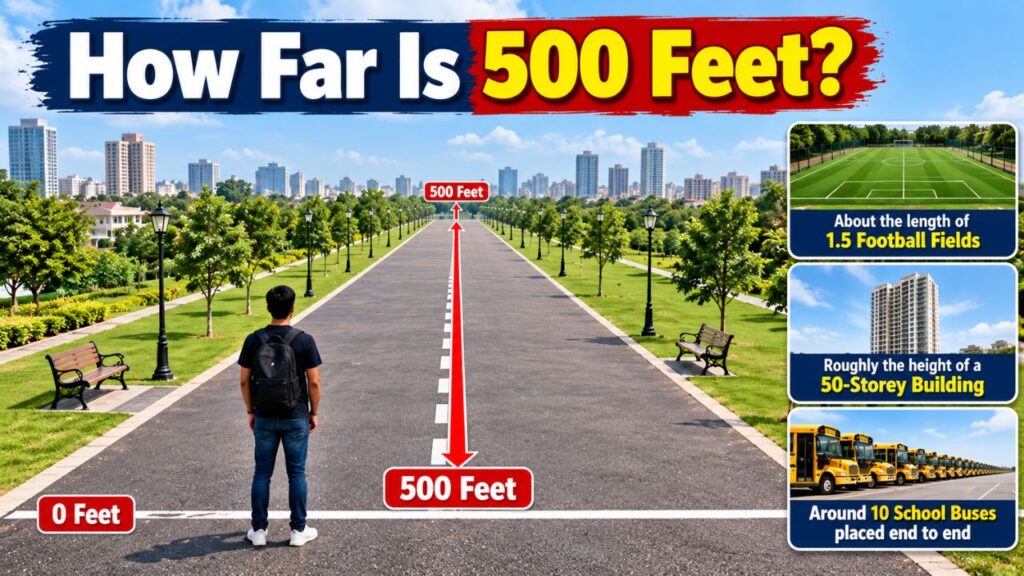
This can be challenging to understand with measurements when you do not have the visualization of how far that distance is in front of you. How much is 500 feet also sounds like a tough question, but knowing what you are comparing with (common objects in measurement) or how far it is on sports grounds, buildings and walking can really help put the number into perspective.
500 feet 152.4 meters (m) 166.67 yards (yd), ~0.095 miles A walking distance that an area that your going to travel between buildings or across a large clearing or short stretch of road.
To know 500 feet distance in other familiar unit, the most convenient way is to convert it into another one. Converts help you understand the distance, be it a road or a walk you are planning or visualizing what letter size an outdoor area coverage would be.
| Measurement Unit | Equivalent Distance |
| Feet | 500 feet |
| Inches | 6,000 inches |
| Meters | 152.4 meters |
| Centimeters | 15,240 centimeters |
| Yards | 166.67 yards |
| Kilometers | 0.1524 kilometers |
| Miles | 0.0947 miles |
Since one foot contains 12 inches, 500 feet equals 6,000 inches. Similarly, multiplying 500 by 0.3048 gives a distance of 152.4 meters.
NOTE: It’s a distance of just under 1/10 mile. When you are estimating a distance on a map or trying to guess how far away something is, it helps to think of 500 feet as roughly just under a tenth-mile.
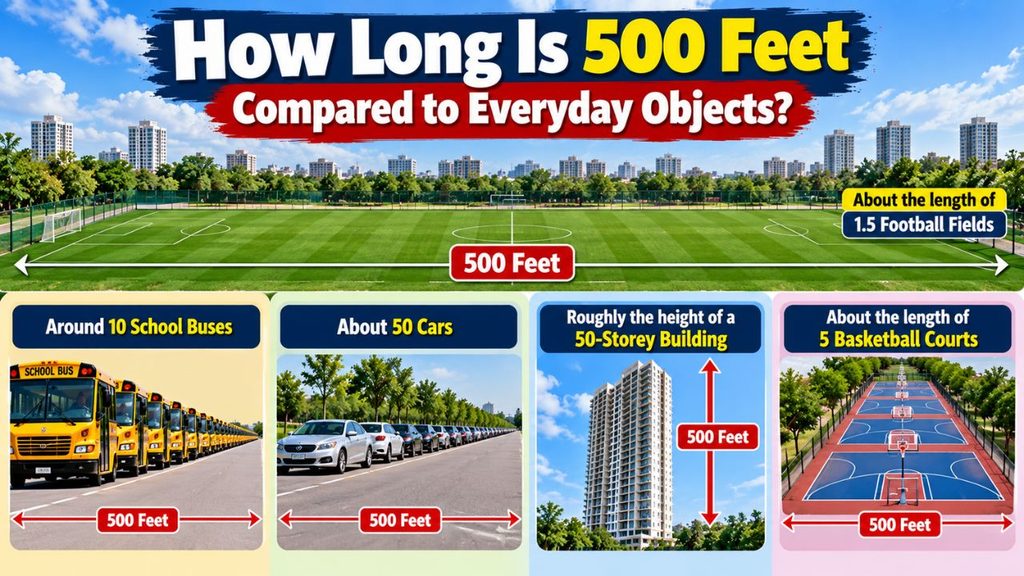
They show us how we can understand very large measurements in terms of everyday objects. Instead of visualizing an unfamiliar number, you can easily compare 500 feet with sports courts, parking spaces, railway coaches or other more familiar things.
E.g. five 100-foot garden hoses chained together = 500 feet exactly This is one of the simplest forms for visualization of distance as the length combined can be calculated directly.
Other objects offer approximate comparisons. They can measure more, but that really depends on their design, size, and use case.
The following examples show how a distance of 500 feet compares with familiar objects and real-world spaces.
| Common Thing | Approximate Comparison | Explanation |
| Five 100-Foot Garden Hoses | Exactly 500 feet | Connecting five hoses that are each 100 feet long creates a combined length of 500 feet when arranged in a straight line. |
| American Football Field | About 1.39 field lengths | An American football field measures 360 feet, including its end zones, so 500 feet is longer than one complete field. |
| Basketball Courts | About 5.3 court lengths | A standard basketball court is 94 feet long, meaning a little over five courts placed end to end would cover 500 feet. |
| City Blocks | Around 1-2 short blocks | Depending on the street layout, 500 feet may cover one or two short city blocks. Block lengths vary considerably between cities. |
| Tall Buildings | Around 40-50 floors | If each floor averages approximately 10-12 feet in height, a building with 40-50 floors can provide a rough vertical comparison. |
| Running Track | About 38% of a lap | A standard outdoor running track measures 400 meters, or approximately 1,312 feet, making 500 feet a little over one-third of a lap. |
| Passenger Airplanes | Around 2 aircraft lengths | Some large passenger airplanes measure approximately 200-250 feet long, so two of them placed end to end could approach 500 feet. |
| Olympic Swimming Pool | Just over 3 pool lengths | An Olympic swimming pool is 50 meters long, equivalent to about 164 feet. Three pool lengths total approximately 492 feet. |
| Telephone Poles | Around 10-15 intervals | If poles are spaced approximately 35-50 feet apart, 500 feet could span around 10-15 intervals. |
| Railway Coaches | Around 10-12 coaches | Depending on the coach design, a line of 10-12 railway coaches could cover a distance close to 500 feet. |
| Large Trees | Around 5-10 tree heights | Trees measuring 50-100 feet tall provide a rough vertical comparison when their heights are combined. |
| Residential Houses | Around 10-15 frontages | If each property frontage measures approximately 30-50 feet, several houses side by side could span 500 feet. |
| Parking Spaces | About 33 spaces | Using a typical parking space length of 15 feet, 33 spaces placed end to end would measure approximately 495 feet. |
| Garden Path | Several connected sections | A 500-foot garden path could run through a large garden or connect several outdoor areas. |
| School Hallways | Several long corridors | Multiple school hallways connected in a straight line could add up to 500 feet, depending on the building layout. |
| Short Roadway | A short stretch of street | A 500-foot road segment can represent the distance between nearby landmarks, entrances, or buildings in some locations. |
These examples are meant to help visualize the measurement instead of giving precise measurements for every single thing. There are exact comparisons from the five garden hoses and unit conversions while buildings, trees, roads and other structures fluctuate in size.
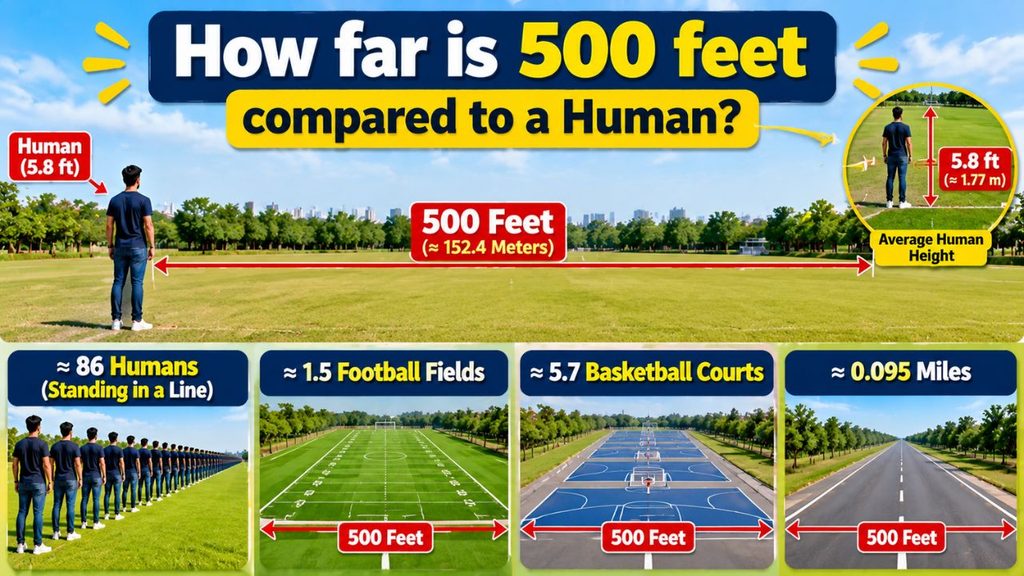
Another helpful reference point for this distance is a person’s height. A 5.5-foot tall adult is equivalent to a person who stands at 5 feet 6 inches.
If you picture stacking people of this height upright, one on top of another, about 91 would reach an aggregate weight of at least 500 feet.
The calculation is:
The answer to 500 ÷ 5.5 = about 90.9 people
They are also just a mathematical comparison, and not a method for measuring distance on the ground in any real sense. But this illustrates that 500 feet is far longer than the height of a person and is a significant horizontal distance when traversing an unobstructed area.
The time per 500-foot journey is based on your speed, the surface upon which you are traveling and stops required for portions of the journey. THE DISTANCE: At an average pace, adults can touch this caliber in about two minutes.
| Activity or Pace | Approximate Time |
| Slow walking | 2-3 minutes |
| Normal walking | Around 2 minutes |
| Brisk walking | Around 1-1.5 minutes |
| Light jogging | Around 45-60 seconds |
| Running | Around 30-45 seconds |
All these estimates assume continuous movement on a flat surface. This time may also vary based on numerous factors like traffic lights, crowd, uneven paths etc.
500 feet is an easy 10–15 minute walk for planning in daily life. Yes,moving from one area of parking/walking to a building entrance/covering distance between two locations for nearest movement in huge complexes.
Knowing how to convert units is useful for reading maps, building plans, real estate measures and road distance signs.
| Unit | Conversion Formula | Result |
| Inches | 500 × 12 | 6,000 inches |
| Yards | 500 ÷ 3 | 166.67 yards |
| Meters | 500 × 0.3048 | 152.4 meters |
| Centimeters | 152.4 × 100 | 15,240 centimeters |
| Kilometers | 152.4 ÷ 1,000 | 0.1524 kilometers |
| Miles | 500 ÷ 5,280 | 0.0947 miles |
The meter conversion is especially handy, since the metric system has been a universal standard for measuring roads, buildings and outdoor areas in quite a few countries.
For instance, you may get a map that shows how far away a destination is – approximately 152 meters.
To calculate this distance, you need not always a measuring tape and special instruments. There are a few easy techniques that can be used to determine if an area is about 500 feet long.
Track steps taken: A normal adult going for a walk can have ~ 2.2–2.5 feets of foot length for each step walked. It would take somewhere around 200-230 steps in that stride length to cover 500 feet. That will be different for you depending on your height, your step, and how you walk.
Use a well known sports field: The American Football Field measures 360 feet in length (including the end zones). That gets you around 500 feet – a whole field and another 140 feet.
A 500-foot measurement can be useful in different settings, from outdoor recreation to construction and transportation.
| Situation | How 500 Feet Is Useful |
| Property Planning | Estimating the length of a large plot, driveway, or outdoor boundary. |
| Construction | Understanding distances on site plans and project layouts. |
| Sports Facilities | Comparing the length of open areas with fields and courts. |
| Road Planning | Measuring a short road segment or distance between nearby points. |
| Walking Routes | Estimating how far a person must walk between two locations. |
| Event Venues | Planning pedestrian routes, entrances, and movement around outdoor spaces. |
| Parks and Gardens | Estimating the length of pathways and landscaped areas. |
| Mapping | Converting a distance shown in feet into meters or miles. |
The utility of this metric is context-dependent. Five hundred feet will be a long distance in a small room but may not be very far at all on a big estate or outdoors.
500 feet is either pretty long, or not bLong but it depends on how you are using the measurement. Which is usually a two minute walk away at a leisurely pace.
But for building, 500 feet can mean extreme verticality or long horizontal extent. It’s less than one-tenth of a mile on a map, and in an expansive park or sports complex it might only take up a small portion.
The context further alters the perception that distance is. For example, walking down a straight-open-path 500 feet may seem easier than walking through a congested building or over uneven ground for that same distance.
Five hundred feet equals 152.4 meters. This conversion is calculated by multiplying 500 by 0.3048, the number of meters in one foot.
Yes. One-tenth of a mile equals 528 feet, so 500 feet is only 28 feet shorter. It is approximately 0.095 miles.
There are approximately 166.67 yards in 500 feet. Since one yard equals three feet, dividing 500 by three gives the answer.
At an average walking pace, 500 feet usually takes around two minutes. A slower pace, uneven terrain, or obstacles can make the journey longer.
Imagine five 100-foot garden hoses connected together, or approximately 1.39 American football field lengths. You can also estimate the distance using about 200-230 walking steps, depending on your stride.
It is easy to start thinking of how far 500 feet really is when you relate the distance to things you know from everyday life and objects. That is equal to 152.4m (or 166.67 yards), or about 0.095 miles – just short of one-tenth of a mile.
You might picture this distance as five connected 100-foot garden hoses, around 33 end-to-end parking spaces, or slightly more than one American football field. Walking at a normal pace, 500 feet roughly takes two minutes.
From estimating a walking path, understanding an area measurement or comparing distances on a map – these scenarios offer practical methods for visualizing 500 feet without needing to step out the measuring tape.
Also Read: How Long Is 13 Inches | How Big Is 10 cm | 8 oz Bag of Chips Size