 11
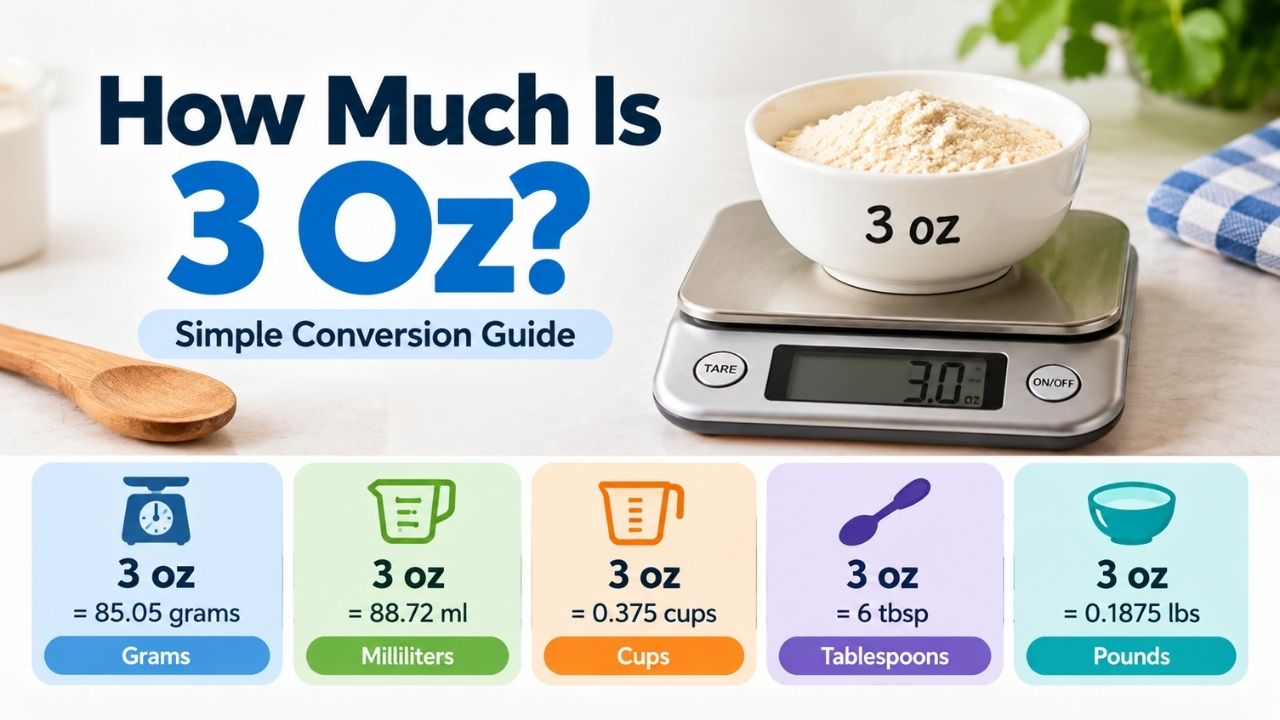
If you ever saw a recipe, label or measurement that specified 3 oz and wondered just how much is 3 oz? The abbreviation for ounce is “oz,” but depending on the sense where it is used, an ounce can be a measure of weight (mass) or fluid volume. Knowing exactly what 3 ounces is, therefore, can come in very handy – especially when baking or cooking, shopping and converting measurements.
So, how much is 3 oz? 3 ounces, weight: 85.05 grams (or ~ 85 g). In pounds, it’s 0.1875 lb, which is incredibly less than one-fifth of a pound. But, if the measurement is fluid ounces then that answer is inaccurate because fluid ounces equals measurement of volume and not weight.
This post lists all the possible definitions of 3 oz, gives some handy conversions, and demonstrates how it stacks up against everyday things.
The simplest answer depends on whether you are measuring weight or liquid.
| Measurement | 3 oz Equivalent |
| Grams | 85.05 g |
| Kilograms | 0.085 kg |
| Pounds | 0.1875 lb |
| Milligrams | 85,048.6 mg |
| Ounces | 3 oz |
| US fluid ounces | 3 fl oz |
| US cups of water | 0.375 cup |
| US tablespoons | 6 tablespoons |
| US teaspoons | 18 teaspoons |
Just for day-to-day purposes: 3 ounces is nearly the weight of 85 grams. So much so that it is THE conversion you most likely need when a recipe or product lists an ingredients weight in ounces.
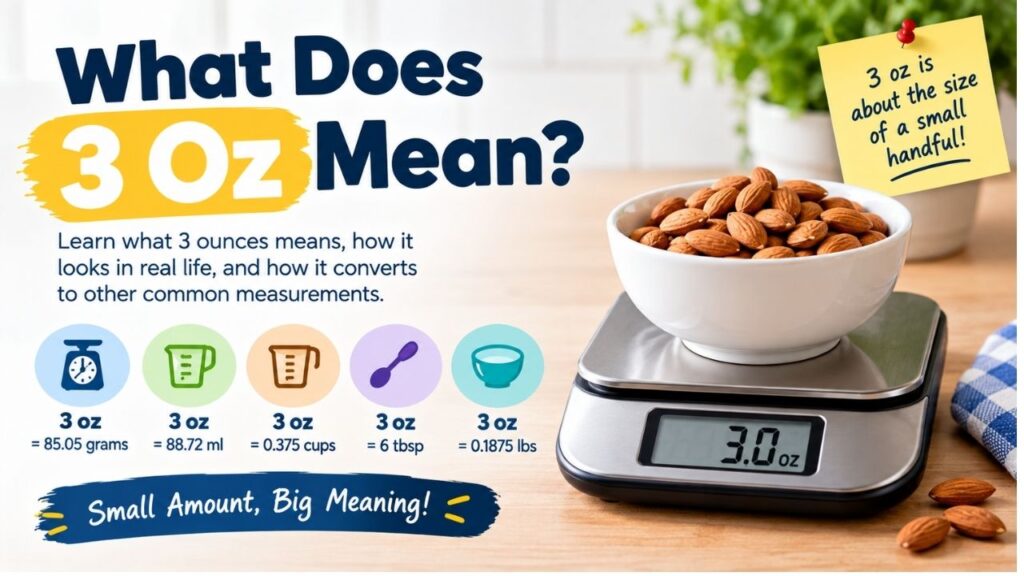
Ounce – An ounce is a unit of mass in the volume (Imperial units and United States customary) systems of measurement known as USCS. One avoirdupois ounce is approximately equal to 28.35 grams
Therefore, 3 ounces can be calculated as:
3 × 28.35 = 85.05 grams
That means 3 oz is about 85 grams.
This is helpful when you have a recipe in ounces (e.g. our heavenly Chocolate Chip Brownies) but your kitchen scale measures grams. With the scale settings guide in grams, weigh out about 85 g.
Keep in mind that ounces and fluid ounces are not the same. You might measure a solid ingredient, like cheese, in weight or a liquid, like milk or water, in fluid ounces.
In terms of weight, 3 oz is about 85.05 grams.
You can round this to 85 grams which is a simple kitchen measurement. The difference created by rounding is very small and can generally be ignored for normal cooking purposes.
| Ounces | Grams |
| 1 oz | 28.35 g |
| 2 oz | 56.70 g |
| 3 oz | 85.05 g |
| 4 oz | 113.40 g |
| 5 oz | 141.75 g |
| 6 oz | 170.10 g |
| 8 oz | 226.80 g |
This clearly shows that 3oz is not a large amount. For instance a food related 85g (essentially residue of prepared neglected sustenances) piece weighs close to an apple, everything considered, maybe more failure than size or thickness.
There are 16 ounces in one pound. Therefore:
3 ÷ 16 = 0.1875 pounds
So, 3 ounces equals 0.1875 lb.
For an easier comparison, you can think of 3 ounces as slightly less than one-fifth of a pound.
| Weight | Equivalent |
| 1 oz | 0.0625 lb |
| 2 oz | 0.125 lb |
| 3 oz | 0.1875 lb |
| 4 oz | 0.25 lb |
| 8 oz | 0.5 lb |
| 16 oz | 1 lb |
This especially helps when purchasing meat, cheese, or other foods that are often sold by the pound.
One kilogram contains 1,000 grams. Considering that 3 ounces is close to about 85.05 grams, the conversion for a kilogram is:
85.05 ÷ 1,000 = 0.08505 kg
Therefore, 3 ounces is approximately 0.085 kilograms.
For quick calculations, you can simply remember:
3 oz ≈ 85 g ≈ 0.085 kg
Kilograms are typically used for bigger amounts, but this conversion is valuable when examining different product specs internationally or finding instances within certain recipes.
But things take a turn when it is -oz-, which refers to – fluid ounces.
Fluid ounces, on the other hand, represent volume – not weight. How Many milliliters (in mL) are What is 3 US fluid ounces? = (≈ 88.
| Volume | 3 US Fluid Oz Equivalent |
| Milliliters | 88.72 mL |
| Liters | 0.0887 L |
| Cups | 0.375 cup |
| Tablespoons | 6 tbsp |
| Teaspoons | 18 tsp |
Hence, 3 fluid ounces is approximately equal to 89 mL.
To understand this better, note that 3 fluid ounces of liquid can vary in weight. Three fluid ounces of water weighs different than three fluid ounces of honey, because their densities are not the same.
Water is a good example since the weight and volume of water are somewhat directly correlated.
An American fluid ounce is equivalent to around 29.573 mL, therefore three US fluid ounces of water has a mass of about 88.7 g (under typical conditions).
This means that 3 bottles of 3 fluid ounces is about equivalent to the weight of 3 ounces, but one measurement measures volume and one measures mass it’s not a strict equivalence.
That is why we estimate that not every fluid ounce of liquid weighs 3 ounces. Density is the factor that distorts mass-volume interplay.
For US measurements, 1 cup contains 8 fluid ounces. Therefore:
3 ÷ 8 = 0.375 cup
So, 3 fluid ounces equals 3/8 of a cup.
It can also be expressed as ¼ cup plus 2 tablespoons, because ¼ cup equals 2 fluid ounces and 1 tablespoon equals 0.5 fluid ounce.
| Measurement | Equivalent to 3 fl oz |
| Cups | 3/8 cup |
| Tablespoons | 6 tbsp |
| Teaspoons | 18 tsp |
This conversion is particularly useful when you do not have a measuring cup specifically marked for fluid ounces.
US fluid ounces compared to tablespoons table. 3 US FL OZ = 6 TBSP
The 1 US fl oz = 2 tablespoons relation (US) makes sense because of that.
Therefore:
3 × 2 = 6 tablespoons
If a recipe calls for 3 fluid ounces of milk, oil, juice or some other liquid then you can measure out 6 tablespoons.
Note that this tablespoon conversion concerns volume! Not to say that 6 tablespoons is always equal to 3 ounces by weight.
The actual measure of 3 ounces varies greatly based upon food. The density of foods varies, which means that the same weight can take more or less space.
Some approximate everyday analogies:
| Food | What 3 oz May Look Like |
| Cooked meat | A small serving |
| Cheese | A few slices or a small chunk |
| Nuts | A small handful |
| Chocolate | A small bar or several pieces |
| Deli meat | Several thin slices |
| Fish | A small individual serving |
| Fruit | A portion of a small fruit |
| Dry pasta | A small serving before cooking |
These are approximations and not accurate measurements. When accuracy is key, like for baking or portion control, though, it’s far more accurate to use a kitchen scale.
The 3 ounces matter, depending on what you are measuring.
Three ounces is usually a small to medium-sized serving for a solid food. Similarly, 3 fluid ounces is also a small volume for liquids, just under half a US cup.
3 ounces of meat can be a conventional single-serving size, whereas 3 ounces of a weighty food like cheese might appear to be far less than 3 ounces of a light food.
The mass of an object should therefore not be confused with its volume.
One of the most common measurement blunders is to misconstrue ounces and fluid ounces as one and the same.
Ounces (oz) typically refer to weight or mass.
Fluid ounces (fl oz) is the volume measurement.
For example:
This difference is especially critical in recipes. Baking tends to be a bit more precise with weights over volume because of the different densities in ingredients as well as packing vs scooping.
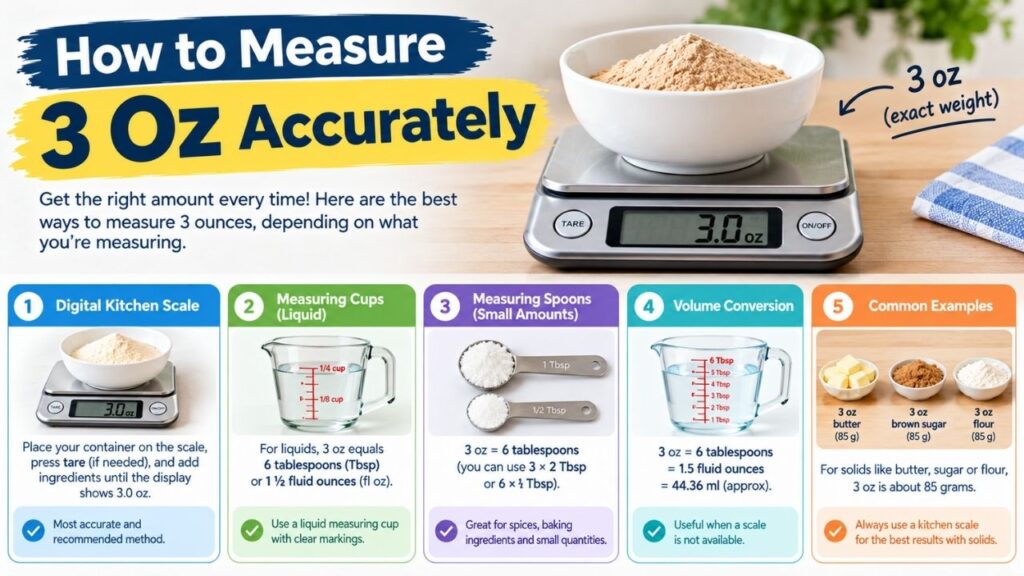
How this works best depends on what you are measuring.
Use a digital kitchen scale. Place it on ounces or grams and measure until the number is 3 ounces (or about 85 grams)
Take a liquid measuring cup or the measuring spoons. In case the recipe calls for 3 fluid ounces, measure about 89 mL.
Quick Tip: Always check if the recipe is telling you to use oz or fl oz. For instance, if you see “3 oz,” check the ingredient and the surrounding instructions to ascertain whether the recipe is asking for weight or volume.
Here is a convenient reference chart for quick conversions:
| Unit | 3 Oz |
| Grams | 85.05 g |
| Kilograms | 0.08505 kg |
| Pounds | 0.1875 lb |
| Milligrams | 85,048.6 mg |
| US fluid ounces | 3 fl oz |
| Milliliters | 88.72 mL |
| Liters | 0.0887 L |
| US cups | 0.375 cup |
| Tablespoons | 6 tbsp |
| Teaspoons | 18 tsp |
Remember that the volume conversions apply specifically to 3 US fluid ounces, while the grams and pounds conversions refer to 3 ounces by weight.
So, how much is 3 oz? If you are talking about the weight, 3 ounces = 85.05 grams, that is equivalent to 0.085 Kgs or even 0.1875 lbs! For liquid volume, 3 US fluid ounces equals 88.72 ml (it’s equal to: 38 cup or 6 tablespoons or nbsp;18 teaspoons)
The crux of the issue is whether this measurement is a measure of weight or volume. After you grasp this difference, converting 3 ounces is easy and helpful in the kitchen for shopping, food portions, and product volume.
The most memorable conversions for everyday use are 3 oz ≈ 85 grams (weight) and 3 fl oz = ≈ 89 mL (liquid volume).
3 oz is approximately 85.05 grams. For everyday measurements, you can round it to 85 grams.
For water or similar liquids, 3 fluid ounces is about 0.375 cup, or ⅜ cup. For dry ingredients, the cup measurement can vary depending on the ingredient.
If you mean 3 US fluid ounces, it equals approximately 88.72 ml. In most cooking situations, you can round this to 89 ml.
It depends on the food. 3 ounces (about 85 grams) can be a small serving of meat, cheese, snacks, or other foods. The actual portion size varies by food type.
3 oz is three times 1 oz. By weight, 3 oz is approximately 85.05 grams, while 1 oz is approximately 28.35 grams.
Also Read: How Big Is an iPhone 14 Pro Max | How Long Is 5 Inches | How Long Is 100 Feet